
We earn a commission if you buy through these links. Learn more
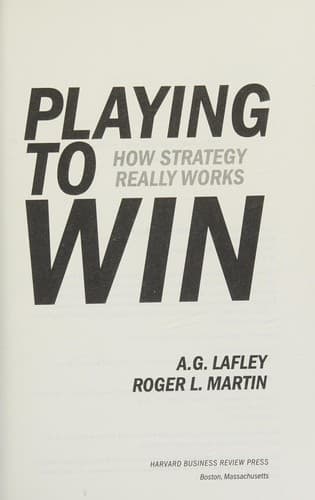
Playing to win
by A. G. Lafley
Guide by the Books of the Day editors · Updated · How we write our guides
A short, practical framework for making real strategic choices, written by former P&G chief executive A.G. Lafley, that turns vague plans into decisions about where to compete and how to win.
What Creators Say About Playing to win
2 creators reviewed Playing to win on YouTube between 2020 and 2024, with 15.8K views between them. Their opinions are their own; we picked these reviews, we didn't write them.
What It's About
Playing to Win is a short business book written by former Procter & Gamble chief executive A.G. Lafley with strategy consultant Roger L. Martin. It rests on one argument: strategy is a set of deliberate choices about where a company will compete and how it will win there, not a forecast, a list of goals, or a statement of good intentions. The authors lay out a framework of five linked questions covering the winning aspiration, where to play, how to win, what capabilities are required, and what management systems will support them. Each question forces a choice, and each choice has to fit with the others.
The approach is grounded in Lafley's experience at P&G and in cases the authors use to show how the questions work in practice, including product and market decisions from the company's own history. Rather than offering a broad theory of competition, the book is mainly a method: a sequence of questions to answer in order, along with tests for whether an answer is actually a choice. Its tone is direct and plain, with many examples of strategies that were vague, contradictory, or that avoided hard trade-offs.
Reading it feels more like sitting in on a working session than studying a textbook. It is quick to get through, and the real value comes from applying the questions to your own business or unit. It is useful for executives, managers writing plans, and anyone who has sat through a strategy offsite that ended without a decision. Expect it to make you uncomfortable about the choices you have been avoiding.
Read this if you…
- lead a business unit or team and need to turn vague goals into concrete decisions
- want a practical framework you can apply to a plan this week rather than abstract theory
- suspect your organization's strategy is really a list of priorities everyone agreed to
Skip it if you…
- are looking for an academic survey of strategy research or competing schools of thought
- want a detailed playbook for a specific industry, since most examples come from consumer goods
Key Ideas
- 1
Strategy is defined by what you refuse
The authors insist that a strategy is shaped as much by what a company decides not to do as by what it pursues. A plan that tries to serve every customer, channel, and product line is closer to a wish list than a strategy. Choosing a specific arena and accepting that other arenas are off limits is what makes limited resources count for something.
- 2
The five questions, asked in sequence
The framework moves from the winning aspiration to where to play, how to win, required capabilities, and supporting management systems. The order matters because each answer constrains the next. Teams that jump straight to how they will win, before settling where they will play, tend to produce plans that sound convincing and go nowhere.
- 3
A genuine right to win
Picking a market is not enough. A company needs a credible reason its capabilities will beat rivals in that market. The book pushes readers to ask honestly why their organization, rather than someone else, should win this business, and to test that answer against real competitors rather than internal optimism.
- 4
Choices must reinforce one another
Individual decisions count as strategy only when they point in the same direction. Pricing, distribution, product design, and marketing should work together. A set of sensible but unrelated moves may look busy, but it does not add up to a position the competition has to respond to.
Limitations
Critics note that the book's evidence leans heavily on Procter & Gamble and on success stories told in hindsight, which can make the framework look more predictive than it is. The examples come mostly from consumer goods and large corporations, so readers in software, services, nonprofits, or small firms will need to translate them. The book also says less about execution, culture, and the politics of getting people to commit to a choice, and it does little with competitive response or disruption. Treat it as a disciplined way to ask questions rather than a guarantee of results.
Questions Readers Ask
- Is Playing to Win still relevant?
- Largely yes, because its core argument about choice and trade-offs does not depend on any particular technology or market. Some examples feel dated, and the book predates much of the current discussion about digital platforms. Read the framework as the lasting part and the case studies as illustrations that you may need to update for your own context.
- How does it compare to Michael Porter's work on strategy?
- Porter's frameworks analyze industry structure and competitive forces from the outside. Lafley and Martin focus on the choices a particular company makes within its own strategy, so the two approaches complement each other. Porter is more theoretical, while this book is more operational and is easier to apply directly to a planning session.
- Published
- 2013
- ISBN
- 9781491528792
- Difficulty
- beginner
- Category
- Leadership
Book details and cover from Google Books.
Ready to read Playing to win?
Get your copy on Amazon, or listen to it on Audible. We earn a commission if you buy through these links.