
We earn a commission if you buy through these links. Learn more
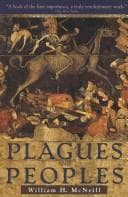
Plagues and Peoples
A sweeping, influential case that infectious disease has been a major force in world history, showing how contact between isolated populations reshaped empires and conquests.
What It's About
Plagues and Peoples is a big-picture argument that epidemic disease has been a major, underrated force in human history, and that the story of civilization is partly a story of microbes moving along trade and conquest routes. McNeill covers a span from early human settlement through the modern era, tracing how diseases spread between populations that had long been separated and how those encounters shaped the outcomes of wars, migrations, and empires.
The book's approach is synthetic rather than archival. McNeill draws on chronicles, medical knowledge, and ecological reasoning to sketch patterns instead of dwelling on individual outbreaks. He introduces two loose categories, microparasitism (infectious disease) and macroparasitism (the way states and armies extract resources from ordinary people), and uses them to think about how societies organized themselves to survive or to exploit one another. Expect long sweeps, confident generalizations, and frequent shifts in geography.
Reading it is less like following a narrative than like being handed a new lens. Chapters move quickly across centuries, so much of the pleasure lies in connecting dots: how Mongol-era travel may have linked disease exposure across Eurasia, or why the Americas' unexposed populations suffered so badly after contact. It rewards patient readers willing to accept interpretation alongside evidence, and it is written in clear prose without technical jargon.
Read this if you…
- want a big-picture history that connects medicine, migration, and empire
- are curious how the encounter between the Old and New Worlds reshaped demographics
- enjoy broad interpretive arguments and don't need every claim fully documented
Skip it if you…
- want a tightly sourced, period-by-period history with modern archaeological and genetic evidence
- prefer narrative history built around named individuals and close-up scenes
Key Ideas
- 1
Disease as an active force in history
McNeill treats epidemics as causes, not background noise. Infection often decided who won a war, which cities survived, and how populations rebuilt, so political and military history looks different once disease is counted as a player rather than a footnote.
- 2
Isolated disease pools and sudden contact
Populations cut off from one another for long periods develop different sets of endemic diseases and immunities. When contact resumes, the newly connected groups can suffer catastrophic losses, a pattern he traces most dramatically after 1492 in the Americas.
- 3
Microparasites and macroparasites
McNeill distinguishes infectious microbes from the social organizations, such as states, armies, and tax systems, that feed on human labor and resources. The comparison is a deliberate analogy, and it helps him frame how societies bargained with both kinds of parasitism.
- 4
Trade routes and the spread of epidemics
Long-distance commerce and conquest carried diseases across continents. The book follows these routes, including the Mongol-era connections that help explain the reach of plague, to show how movement of people and goods shaped the timing and geography of outbreaks.
- 5
Rhythm, ritual, and group bonding
McNeill argues that synchronized activity such as dance, ritual, and military drill helped humans bond into larger groups. He presents this as one way communities held together under pressure, linking social cohesion to the wider historical story.
Limitations
Critics point out that the book's evidence is uneven, especially for early periods where records are thin, so some sweeping claims rest on inference. Its perspective is largely Eurasian and Western-centered, and it gives limited attention to the experiences of ordinary people and to non-European societies on their own terms. Population estimates for the Americas and other regions have been substantially revised by later scholarship, and the macroparasitism framework is more metaphor than tested theory. Several specialists have since produced more detailed work on individual diseases and regions.
Questions Readers Ask
- Is Plagues and Peoples still worth reading given newer research?
- Yes, as an interpretive classic. McNeill's framework shaped later histories of disease, and the book is still a useful starting point. However, some early-period claims and population figures rest on older evidence and have been revised since. Read it as a foundation to build on rather than the final word on the subject.
- How does it compare to Guns, Germs, and Steel?
- Both are sweeping books that argue biology and environment shaped large patterns of history. McNeill is narrower in focus, concentrating on disease and human contact rather than a full range of geographic explanations. He is also less interested in a single causal theory. Readers who want one tightly argued thesis may find Diamond's book more focused.
- Published
- 1976
- ISBN
- 9789864790784
- Difficulty
- intermediate
- Category
- History
Book details and cover from Google Books.
Ready to read Plagues and Peoples?
Get your copy on Amazon, or listen to it on Audible. We earn a commission if you buy through these links.