
We earn a commission if you buy through these links. Learn more
Periodic Tales
Guide by the Books of the Day editors · Updated · How we write our guides
A curious, essay-style tour of the chemical elements through their names, discovery stories, and roles in everyday life, offering a human side to the periodic table that a chemistry textbook rarely reaches.
What Creators Say About Periodic Tales
2 creators reviewed Periodic Tales on YouTube between 2012 and 2015, with 1.4K views between them. Their opinions are their own; we picked these reviews, we didn't write them.
What It's About
Periodic Tales is a cultural history of the chemical elements, written by a British writer with a designer's eye for materials and objects. Rather than teaching chemistry, it uses the familiar periodic table as a starting point and asks how each element got its name, where it was found, and what people have done with it. The chapters move between laboratory history, industry, art, and folklore, so a single substance can lead to a discussion of coinage, medicine, or warfare.
The approach is digressive and curious rather than systematic. Aldersey-Williams is more interested in anecdote and association than in a complete inventory, so some elements get extended treatment while others appear only briefly. Readers who want a full account of atomic structure or chemical bonding will find little of that here, and the tone leans toward enthusiasm and wonder.
Reading it feels like walking through a museum with a knowledgeable guide who keeps stopping at unexpected cabinets. It rewards dipping in and out and works well one section at a time. Expect a light scientific touch, plenty of cultural context, and a steady sense that ordinary materials have stranger histories than they seem to.
Read this if you…
- are curious about the history behind everyday materials and objects
- enjoy popular science written as essays and anecdotes rather than lessons
- want a gentle introduction to chemistry through its human and cultural side
Skip it if you…
- need a rigorous, up-to-date chemistry course or exam preparation
- want a tightly plotted argument or narrative that builds from start to finish
Key Ideas
- 1
Elements have biographies, not just properties
The book treats each element as a character with a history: where it came from, who first isolated it, and how its reputation shifted over time. That framing makes dry facts about density or melting points feel like parts of a story rather than entries in a table.
- 2
Names and discovery stories shape how we see matter
Many elements were named after places, gods, planets, or the people who fought over their discovery. Aldersey-Williams shows how these naming choices and priority disputes influenced scientific culture and the way the public came to understand the substances involved.
- 3
Everyday materials are tied to empire and industry
Familiar metals and minerals turn out to be connected to trade routes, colonial extraction, wartime demand, and manufacturing booms. The book uses these links to argue that the periodic table is also a map of economic and political history.
- 4
The table as a lens rather than a textbook
The periodic table serves mainly as an organizing device. The author uses its layout to move between topics, so the book reads as a set of linked essays and not a sequence of lessons that must be followed in order.
Limitations
Published in 2011, the book predates some later developments, including newly synthesized heavy elements and recent work on supply and recycling, so certain details may feel dated. The selection of elements is idiosyncratic, and some readers find the structure meandering or uneven in depth. It is also not a source for the science itself, so anyone relying on it for technical accuracy should check a current chemistry reference.
Questions Readers Ask
- Do I need a science background to enjoy Periodic Tales?
- No. The book assumes only a general curiosity about the world. Chemical ideas appear when they help tell a story, and they are explained in plain language. Readers with a school-level grasp of the periodic table will find it easy going, and those with none will still follow the historical and cultural threads without difficulty.
- How does it compare with Mark Miodownik's Stuff Matters?
- Both books explore the materials around us through history and everyday objects. Periodic Tales is organized around the elements and reads more like a set of cultural essays. Stuff Matters focuses more closely on how materials work and are engineered, so choose based on whether you want the stories behind substances or the science of how they perform.
- Is it still worth reading given how much chemistry has changed?
- Yes, if you read it for the history rather than the current science. The cultural stories about naming, discovery, and industrial use hold up well. Just treat any technical or statistical detail as a snapshot from the early 2010s and verify it against newer sources.
- Published
- 2011
- ISBN
- 9780670919468
- Difficulty
- beginner
- Category
- Science
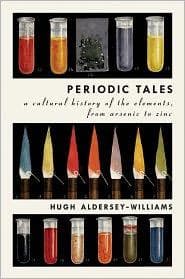
Book details and cover from Google Books.
Ready to read Periodic Tales?
Get your copy on Amazon, or listen to it on Audible. We earn a commission if you buy through these links.