
We earn a commission if you buy through these links. Learn more
Pedro Páramo
by Juan Rulfo
A short, haunting Mexican novel that turns a son's search for his father into a fragmented journey through a town of ghosts, rewarding patient readers with unforgettable atmosphere.
What It's About
Pedro Páramo, published in 1955, is a short Mexican novel that reads more like a haunting than a conventional story. Juan Preciado travels to the town of Comala after his dying mother asks him to find the father he has never met. Once he arrives, the town seems emptied of the living, and the book stops following him in any straight line.
Rulfo does not tell the story in order. Scenes jump across decades, voices speak without attribution, and characters who should be dead keep talking, remembering, and arguing about old debts and desires. Dialogue often arrives without quotation marks or identifying tags, so readers have to work out who is speaking. The prose is spare and rhythmic, closer to poetry or oral storytelling than to realist fiction, and the sentences carry a lot of weight.
Reading it feels like piecing together a broken mosaic. It is short enough to finish in a single sitting, but it asks you to hold on to threads and return to earlier passages. The experience is eerie and melancholic rather than plot-driven, and the rewards come from the accumulation of voices and atmosphere more than from any one revelation.
Read this if you…
- want a short novel that rewards careful, rereading attention
- are drawn to Latin American fiction with ghostly or mythic elements
- enjoy atmosphere and voice more than a tidy plot
Skip it if you…
- need a clear chronological story with a conventional narrator
- find gloomy, bleak settings hard to sit with
Key Ideas
- 1
A town built on memory and ghosts
Comala is less a backdrop than a presence. The living and the dead share the same space, and the past refuses to stay finished. Rulfo uses the village to show how a community can be shaped by memories it cannot let go of, so the setting itself carries the emotional weight of the book.
- 2
Power, cruelty, and the local landowner
Pedro Páramo is a landowner whose control extends into nearly every relationship around him. The novel shows how domination warps families, love, and the local economy, and how the people beneath him absorb the damage. Authority here is personal as well as economic, which makes it feel intimate and suffocating.
- 3
Fragmented time and overlapping voices
Rather than a timeline, the book is assembled from perspectives that overlap and contradict one another. Meaning emerges from how fragments echo each other. The structure makes you experience the disorientation of a place where history cannot be sorted neatly into before and after.
- 4
Rural Mexico after upheaval
The novel draws on the aftermath of the Mexican Revolution and the hardship of life in the countryside. It works more as a mood than a documentary, but scarred land, debts, and emptied farms give its ghostly atmosphere a social foundation that grounds the supernatural elements.
- 5
Language stripped to essentials
The prose is compressed, with images doing much of the work in very few words. Its economy is a large part of why the book has been so influential across Latin American writing, and it rewards slow reading in which each line is weighed rather than skimmed.
Limitations
The fragmentation can frustrate readers who want clear plot and characterization, and some figures blur together, so the chronology demands real effort. Women's roles are often narrow and seen largely through male desire, which many readers find dated. Some find the mood relentlessly grim. Because the book is so short, readers who want deep psychological interiority may find its characters sparse.
Questions Readers Ask
- Is Pedro Páramo worth reading if I do not know Latin American literature?
- Yes. The novel is short and does not require background knowledge to follow its emotional core. Familiarity with Mexican history and rural life adds depth, but a first-time reader can still be moved by the voices and the haunting atmosphere. Expect to read slowly and be patient with the structure.
- How does it compare to One Hundred Years of Solitude?
- Both are Latin American novels with ghostly and mythic textures, and Rulfo's influence on later writers is widely noted. Rulfo's book is much shorter, bleaker, and more fragmented. García Márquez offers a sprawling family saga with more humor. Readers who enjoy one often find the other rewarding.
- Is it still relevant today?
- Yes. It remains widely taught and read, and its treatment of memory, inherited power, and grief still resonates with contemporary readers. Its brevity also makes it an accessible entry point into experimental fiction.
- Published
- 1955
- ISBN
- 9798663628426
- Difficulty
- intermediate
- Category
- Fiction
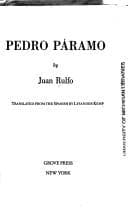
Book details and cover from Google Books.
Ready to read Pedro Páramo?
Get your copy on Amazon, or listen to it on Audible. We earn a commission if you buy through these links.