
We earn a commission if you buy through these links. Learn more
Peak
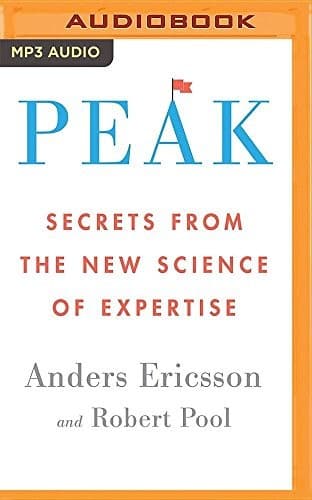
by Anders Ericsson, Robert Pool
Ericsson's own account of deliberate practice, with a clear case that how you practice matters more than innate talent, and a sharp correction to the 10,000-hour myth.
What It's About
Peak is written by Anders Ericsson, a psychologist who spent decades studying how people become exceptional, with science writer Robert Pool helping shape the material for general readers. Its central claim is that expertise is built far more by the way practice is done than by innate gifts. It sets out to replace the popular story of talent and the 10,000-hour rule with a more precise account of what actually drives improvement.
The book draws on research from music, chess, sports, and memory, using case studies of people who improved dramatically through focused training. Ericsson explains what separates effortful deliberate practice from simply putting in time, and describes mental representations, the internal models experts use to perceive patterns and plan their next move. The tone is explanatory rather than breezy, and the stories mostly serve the argument.
Reading it feels like sitting in on a research seminar with an author who is convinced and occasionally combative. Expect practical implications for teachers, coaches, and self-learners rather than a step-by-step program. It rewards readers who are willing to think critically about how they practice, and it is most useful when you already have a skill you want to improve.
Read this if you…
- want a clear explanation of how expertise develops in music, sport, or chess
- are a teacher, coach, or manager who wants evidence-based ideas about training
- already have a skill you want to improve and are willing to change how you practice
Skip it if you…
- want a light, story-driven book about success or motivation
- are looking for a ready-made training plan with exercises for a specific skill
Key Ideas
- 1
Deliberate practice is not just repetition
Ericsson separates deliberate practice from playing or working for hours on end. Deliberate practice targets a specific weakness, sits just beyond your current ability, and demands full concentration. Most people, he argues, spend their time in comfortable routines that stop producing gains after a while, which is why years of experience do not automatically make someone excellent.
- 2
Specific goals and feedback drive improvement
The book stresses that improvement depends on knowing exactly what you are trying to fix and getting quick, accurate information about whether you succeeded. Without a clear target and reliable feedback, practice tends to reinforce existing habits, including mistakes. Ericsson uses examples from music and sport to show how skilled teachers structure this loop.
- 3
Mental representations explain expert performance
Ericsson argues that much of what looks like instinct in experts is really a rich internal model built through practice. These representations let people notice details others miss and plan ahead. He presents this idea as the key mechanism behind expertise, and it is the part of the book that most distinguishes it from ordinary advice about hard work.
- 4
The 10,000-hour rule misreads the research
Ericsson makes a sustained case that the popular 10,000-hour idea oversimplifies his findings. Hours alone do not determine results. The quality of practice, the starting point, and the domain all matter. He uses this correction to argue that talent is less fixed than the popular story suggests, though he does not claim it is irrelevant.
Limitations
Critics have argued that deliberate practice explains less of the difference between performers than Ericsson suggests, especially in some fields, and that other factors such as early environment, opportunity, and luck play larger roles. The book gives relatively little attention to motivation and emotion, and its tone toward critics can feel defensive. Some studies it relies on are small, and the author's strong position on his own work is worth weighing against the wider literature.
Questions Readers Ask
- Is Peak still relevant today?
- Yes, mainly for its core ideas about how practice quality shapes skill and its critique of the 10,000-hour rule. Some of the research debate has moved on since publication, so read it alongside more recent discussions of practice and performance to get a balanced view of what the evidence supports.
- How does Peak compare to Outliers by Malcolm Gladwell?
- Gladwell's Outliers is a more narrative, story-led book that popularized the 10,000-hour idea. Peak is written from inside the research and is largely a response to that popularization. If you want engaging stories, start with Gladwell; if you want the scientist's own explanation and correction, Peak is the better choice.
- Published
- 2016
- ISBN
- 9781473513143
- Difficulty
- intermediate
- Category
- Excellence
Book details and cover from Google Books.
Ready to read Peak?
Get your copy on Amazon, or listen to it on Audible. We earn a commission if you buy through these links.