
We earn a commission if you buy through these links. Learn more
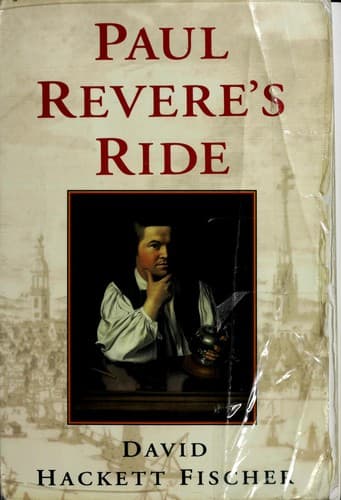
Paul Revere's Ride
Guide by the Books of the Day editors · Updated · How we write our guides
A close, myth-correcting look at one night in 1775 that shows how the American Revolution began through a web of messengers and ordinary people, not a single hero.
What Creators Say About Paul Revere's Ride
2 creators reviewed Paul Revere's Ride on YouTube between 2021 and 2024, with 345 views between them. Their opinions are their own; we picked these reviews, we didn't write them.
What It's About
Paul Revere's Ride is a focused event history that opens onto a much larger story. Its subject is the night of April 18, 1775, when British troops marched out of Boston toward Lexington and Concord, and the colonial alarm that spread in response. Fischer uses that one night to ask how a scattered, largely provincial resistance learned about a military move and reacted within hours. Revere is the book's most famous figure, but Fischer treats him as one link in a much longer chain.
The approach is that of a careful historian working through sources: letters, committee records, testimony, and the accounts written decades later that shaped the legend. Fischer spends real effort separating what happened from what Longfellow's poem and later retellings made of it, and he is willing to correct the record in ways that may surprise readers who learned the story in school. The prose is clear and brisk for a work of this kind, but it is dense with names, places, and timings, so you will need to hold a lot of detail in mind.
Reading it feels like watching a investigator reconstruct a single evening from many witnesses, with the wider Revolution gradually coming into focus behind the events. The payoff is less a single revelation than a better understanding of how the war began: not with one rider, but with a network of people who had been preparing for exactly this kind of night.
Read this if you…
- want the real story behind the Paul Revere legend and enjoy seeing a familiar tale taken apart with evidence
- are interested in how the American Revolution actually started on the ground, town by town
- like detailed event history that rewards patience and careful attention to sources
Skip it if you…
- want a light, narrative-driven story with a clear arc and few names to track
- are looking for a broad survey of the whole Revolutionary War or its political ideas
Key Ideas
- 1
The legend versus the historical record
Fischer works to separate the documented events of April 1775 from the myth built up around them, especially the image of a lone rider galloping through sleeping villages. He shows how later writing, including Longfellow's poem, reshaped the story, and he is clear about which details rest on evidence and which do not.
- 2
A network of riders, not a lone hero
Revere was one of several men carrying word that night, and he was stopped before reaching Concord. Fischer argues that the alarm worked because of many overlapping messengers, local committees, and relays, a pattern that tells you more about how the Revolution functioned than any single ride does.
- 3
Intelligence and secrecy on both sides
The British attempt to move quietly and the colonists' effort to detect it were two sides of the same contest. The book shows how information was gathered, guarded, and sometimes leaked in a town where many people had reason to watch the redcoats closely.
- 4
How a rural society moved information fast
Fischer pays attention to the everyday mechanics of communication in 1775: horses, signals, meeting houses, and the habits of militia towns. This focus makes the book useful for anyone curious about how pre-industrial societies coordinated under pressure.
Limitations
The book is tightly centered on one night and its immediate context, so it does not offer a full account of the war that followed, the debates over independence, or the experiences of enslaved people and Loyalists in the same period. Its density can feel heavy for readers without some background in colonial Massachusetts. Some of its interpretations, particularly its emphasis on the messenger network and its readings of contested sources, invite debate among historians. Readers should treat it as a strong, well-argued case rather than the final word on every detail.
Questions Readers Ask
- Is Paul Revere's Ride a good first book on the American Revolution?
- Probably not as a first book. It assumes you can follow many names, places, and timings, and it is narrow in scope. It works better after a general overview of the Revolution, which will give you the context needed to appreciate Fischer's corrections and the network argument.
- Does the book confirm the story from Longfellow's poem?
- No. Fischer's main purpose is to show where the poem and later retellings departed from the documentary record. Readers who love the poem can still enjoy the book, but they should expect a more complicated and less heroic picture of Revere's role.
- Published
- 1995
- ISBN
- 9780195098310
- Difficulty
- intermediate
- Category
- History
Book details and cover from Google Books.
Ready to read Paul Revere's Ride?
Get your copy on Amazon, or listen to it on Audible. We earn a commission if you buy through these links.