
We earn a commission if you buy through these links. Learn more
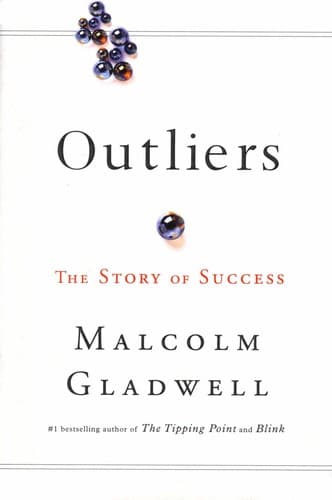
Outliers
Outliers makes a vivid, provocative case that success depends as much on timing, opportunity, and inherited culture as on individual talent, though its evidence is often looser than its confident tone suggests.
What It's About
Outliers is Malcolm Gladwell's 2008 book about why some people achieve extraordinary things. Gladwell rejects the common picture of the self-made genius and asks a different question: what circumstances, accidents of birth, and cultural habits shaped the people who ended up at the top? He builds each chapter around a memorable case, such as star hockey players, computer pioneers, and airline crashes, and then widens the lens to a broader pattern.
The approach is storytelling first. Gladwell moves between research summaries, interviews, and historical detail, and he is good at making unfamiliar studies feel immediate. Reading it feels like being guided through a series of surprising puzzles by a confident narrator who enjoys the reveal. The pace is quick, the sentences are clean, and most chapters can be read in one sitting.
The experience is pleasurable but leaves you wanting to check the reasoning. Gladwell often moves from a striking example to a general rule faster than the evidence allows, so the book works best as a set of hypotheses to test rather than settled science. Readers who enjoy thinking about how luck and environment shape outcomes will find it stimulating. Readers who want rigorous proof will need to look elsewhere.
Read this if you…
- want a readable introduction to how luck, timing, and environment shape careers and achievement
- enjoy long-form narrative nonfiction that connects surprising research to everyday life
- are interested in rethinking the myth of the self-made success story
Skip it if you…
- need rigorous, citation-heavy research or detailed statistical analysis
- already know the sociology of achievement and want new evidence rather than a popular synthesis
Key Ideas
- 1
Opportunity matters as much as talent
Gladwell argues that the people who become exceptional often have unusual access to chances that others lack, whether that is the right time and place of birth, a school with unusual resources, or early exposure to a skill. Talent is necessary, but he treats the distribution of opportunity as the hidden variable that explains who gets to use their talent fully.
- 2
The idea of accumulated practice
The book popularized the notion that elite performers in many fields have logged a very large amount of focused practice, often summarized as ten thousand hours. Gladwell presents this as a pattern in expert performance rather than a fixed threshold, and it is one of the book's most quoted but also most debated claims.
- 3
Birth timing and arbitrary cutoffs
One of the book's best-known examples concerns youth sports, where children born early in the selection year tend to be older and more developed than their peers and so get more coaching. Gladwell shows how a small age advantage, multiplied by institutional choices, can compound into large differences in later success.
- 4
Culture shapes how people work together
Gladwell looks at how cultural habits, such as attitudes toward authority and the way communication happens in a group, can affect outcomes in high-stakes settings. He uses airline safety as a case to argue that deference and indirect speech can be dangerous when they prevent people from raising problems.
- 5
Success is a story about inheritance
The closing argument is that successful people are shaped by legacies that stretch back generations, including work habits, traditions, and the historical circumstances their families and communities lived through. The point is less about individual virtue than about the hidden advantages and burdens people inherit.
Limitations
Critics have argued that Gladwell often draws sweeping conclusions from a few striking anecdotes and selects examples that support his thesis. Some specific claims, especially the ten-thousand-hour idea, were stretched beyond what the underlying research showed, and the original researchers have disputed the simplified version. The book also tends to treat cultural explanations and individual choices as separate categories when they overlap. Readers should treat its examples as illustrations and check primary sources before relying on them.
Questions Readers Ask
- Is Outliers still worth reading today?
- Yes, as an accessible introduction to ideas about opportunity, timing, and environment in achievement. Its specific research claims have been challenged in the years since publication, so read it for the questions it raises rather than as a final verdict. Pairing it with later critiques gives a fuller picture.
- How does Outliers compare to Gladwell's other books?
- It follows the same formula as The Tipping Point and Blink: a central thesis illustrated through vivid case studies. Outliers is more explicitly about why some people succeed, while his earlier books focus more on social epidemics and snap judgments. If you liked his style, the format will feel familiar.
- Who is the book best suited for?
- It suits general readers, students, and anyone curious about careers, education, or sports who wants an engaging overview. It is less suited to academic readers or those who want to verify each claim independently, since the book prioritizes narrative over exhaustive sourcing.
- Published
- 2008
- ISBN
- 9788575421188
- Difficulty
- beginner
- Category
- Psychology
Book details and cover from Google Books.
Ready to read Outliers?
Get your copy on Amazon, or listen to it on Audible. We earn a commission if you buy through these links.