
We earn a commission if you buy through these links. Learn more
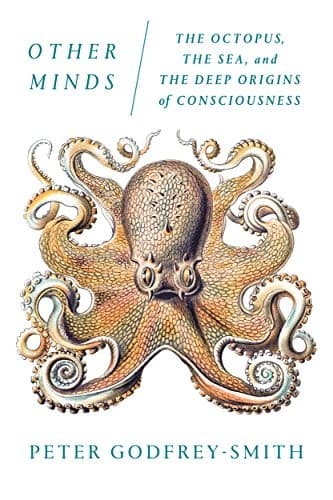
Other Minds
A philosopher's patient, hedged attempt to imagine a mind built nothing like ours, using the octopus as a guide to how consciousness might arise.
What It's About
Other Minds is a book about what it might be like to be a mind unlike ours. Peter Godfrey-Smith, a philosopher of science who also dives and watches animals in the wild, uses the octopus as his central case. Its nervous system is organized very differently from a mammal's: most of its neurons sit in its arms, which can taste, grip, and act with a surprising degree of independence from the central brain. The octopus and we share a common ancestor, but that ancestor was a simple, worm-like creature hundreds of millions of years ago, which makes the octopus about as close as we can get to a mind that evolved on another planet.
The book moves between observations of marine life, research on octopus behavior, and philosophical argument about consciousness. Godfrey-Smith writes as someone thinking aloud, testing ideas and admitting where the evidence runs out. Chapters move from tide pools and dives into questions about what sentience is, whether it comes in degrees, and how we might recognize it in creatures that do not share our body plan. The tone is conversational and unhurried, with plenty of plain description of the animals themselves.
Reading it feels less like being handed a settled answer than like following a careful mind through a hard problem. It rewards patience, especially in the middle sections where the argument slows to draw distinctions. Readers who want quick takeaways may find it meandering, but those who enjoy watching a thinker reason in public will find it absorbing.
Read this if you…
- are curious about animal intelligence and want more than a list of impressive octopus tricks
- enjoy philosophy that reasons through concrete examples from nature
- want to think seriously about how consciousness might be recognized in very different creatures
Skip it if you…
- want a tidy, confident answer about whether animals feel pain or have inner lives
- prefer science books organized around clear, quotable findings rather than an author working through his own doubts
Key Ideas
- 1
Complex minds can evolve more than once
Vertebrates and cephalopods both developed sophisticated behavior, but from very distant starting points. Godfrey-Smith uses this convergence to ask how much of intelligence depends on a particular lineage and how much is a general answer evolution keeps finding when animals need to solve problems, learn, and act in changing environments.
- 2
Consciousness may come in degrees
Rather than treating awareness as an on-off switch that humans either have or lack, the book considers the possibility that experience is spread along a spectrum. This shifts the question from whether an animal is conscious to how much, in what forms, and with what kind of inner life, which he argues is a more productive way to think.
- 3
Bodies shape what a mind can be
The octopus's arms carry a lot of processing and sensing, so its control is distributed rather than centralized. Godfrey-Smith argues that a mind cannot be understood apart from the body and surroundings it operates through, and that our human-centered picture of a single command center may be misleading when we think about other animals.
- 4
Judging minds we cannot easily read
How do we recognize experience in a creature that cannot talk to us and whose behavior we interpret through our own habits? The book examines the risks of projecting human traits onto animals and the limits of behavior as evidence, offering a cautious method rather than a confident verdict.
Limitations
The book is more a set of reflections than a survey of the research, so readers looking for a comprehensive account of octopus neuroscience or behavioral experiments will need other sources. Some critics find the philosophical sections slow, and the central claims about consciousness remain speculative by design. Because the field of animal cognition has moved quickly since publication, certain empirical details may now be outdated, though the core questions the book raises remain open.
Questions Readers Ask
- Who is Other Minds best suited for?
- It suits general readers who like thoughtful science writing and do not mind a philosophical pace. You do not need a background in biology or philosophy, but the middle chapters ask you to follow an argument closely. If you enjoy nature writing with a reflective, questioning voice, you will likely find it rewarding.
- Is Other Minds still relevant today?
- Yes. The central questions about how minds evolve and how we recognize consciousness in other beings are still actively debated. Some specific research has advanced since the book appeared, but its framing of the problem remains useful, and it is often cited as an accessible entry point into these debates.
- How does it compare to Peter Godfrey-Smith's later work?
- Other Minds is his most accessible book on these themes and centers the octopus as a case study. His later writing on the origins of animal life goes wider in time and scope. If you liked the octopus material, the earlier book is the better starting point for most readers.
- Published
- 2016
- ISBN
- 9780008226299
- Difficulty
- intermediate
- Category
- Science
Book details and cover from Google Books.
Ready to read Other Minds?
Get your copy on Amazon, or listen to it on Audible. We earn a commission if you buy through these links.