
We earn a commission if you buy through these links. Learn more
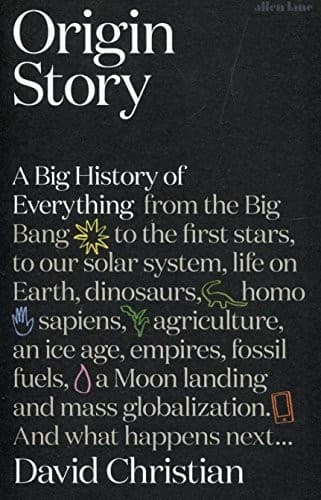
Origin Story
Guide by the Books of the Day editors · Updated · How we write our guides
Origin Story makes the case that the universe, Earth, life and humans form one continuous history, and it is a rare big-picture book that stays concrete and readable.
What Creators Say About Origin Story
2 creators reviewed Origin Story on YouTube between 2023 and 2025, with 1.5K views between them. Their opinions are their own; we picked these reviews, we didn't write them.
What It's About
Origin Story, published in 2018, is David Christian's attempt to tell the whole story of what has happened, from the Big Bang to the present, as a single chain of connected developments. Christian, a historian who helped develop the field known as Big History, treats the universe, the solar system, life and human societies as parts of one account rather than as separate disciplines.
The book is organized around thresholds, moments when new kinds of complexity appear, such as stars forging chemical elements, life emerging, or humans developing farming and cities. Christian pays close attention to how energy flows and why some conditions allow complexity to build while others do not. He draws on physics, chemistry, biology and anthropology to explain why these transitions happen, not just that they did.
Reading it feels like being guided through a long lecture series by a patient teacher. The pace is brisk, the tone is warm, and the scale is dizzying. You will not get deep archival detail about any single era. What you get is a framework for seeing how the pieces relate to each other.
Read this if you…
- want a single framework that connects physics, biology and human history
- enjoy big-picture synthesis and don't mind a lot of ideas packed into each chapter
- are a teacher, student or curious beginner looking for a broad introduction to Big History
Skip it if you…
- want detailed narrative history of one period, region or person
- are looking for a deeply argued thesis you can test against specialist research
Key Ideas
- 1
History as one continuous story
Christian's central move is to refuse the usual division between natural history and human history. Stars, planets, living things and societies are presented as stages of a single process of change. The payoff is a sense that human events are one chapter in a much longer account, which can make familiar events look strange and newly connected.
- 2
Thresholds of increasing complexity
The book organizes its story around threshold moments when a new level of complexity becomes possible. Each threshold builds on the last, and Christian asks what conditions made each leap work. Readers who like to see cause and effect across very long spans will find this structure the most satisfying part of the book.
- 3
Energy flow and favorable conditions
A recurring theme is that complexity depends on a steady flow of energy and on conditions that are neither too harsh nor too static. Christian uses this idea to explain why certain environments allowed stars, chemistry and life to develop. It gives the narrative a physical logic that goes beyond simple timelines.
- 4
Humans as a late but decisive shift
Human history occupies only a sliver of the timeline, yet Christian argues that our ability to store and share knowledge changed how fast complexity could grow. He presents collective learning as a new kind of process, one that accelerates change. Readers interested in why humans transformed the planet so quickly will find this section especially useful.
Limitations
The book's breadth is also its main constraint. Each science and history topic is compressed, so specialists may find explanations thin, and general readers may need to look elsewhere for depth. Some critics argue that the thresholds framework leans toward a progressive story in which complexity builds toward humanity, which can make the narrative feel more inevitable than the evidence supports. Because scientific knowledge has moved on since 2018, some specific details may be outdated.
Questions Readers Ask
- Is Origin Story still relevant today?
- Yes, as an overview. Its central idea of connecting cosmic, planetary and human history remains a useful framework, and it is a good starting point for the Big History field. For the latest findings in cosmology, geology or genetics, however, you will want to supplement it with newer books or articles.
- How does Origin Story compare to Sapiens?
- Sapiens focuses mainly on humans and their societies over the last few hundred thousand years. Origin Story begins with the Big Bang and treats humans as one stage in a longer process. It is more science-heavy and covers more ground, so it suits readers who want the wider context more than a focus on human culture.
- Published
- 2018
- ISBN
- 9780241254684
- Difficulty
- intermediate
- Category
- History
Book details and cover from Google Books.
Ready to read Origin Story?
Get your copy on Amazon, or listen to it on Audible. We earn a commission if you buy through these links.