
We earn a commission if you buy through these links. Learn more
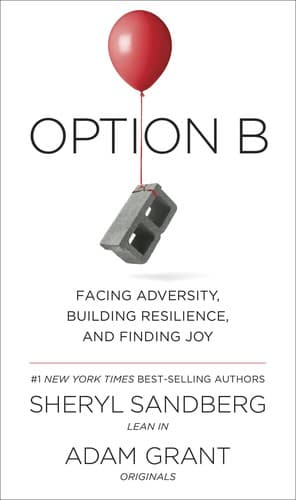
Option B
by Sheryl Sandberg, Adam Grant
Guide by the Books of the Day editors · Updated · How we write our guides
A short, candid book on grief and resilience from Sheryl Sandberg and Adam Grant, pairing her personal loss with his research into practical ways to recover.
What Creators Say About Option B
2 creators reviewed Option B on YouTube between 2017 and 2019, with 120.6K views between them. Their opinions are their own; we picked these reviews, we didn't write them.
What It's About
Option B is a short book co-written by Sheryl Sandberg, the former Facebook operating chief, and Adam Grant, an organizational psychologist at Wharton. It was written after Sandberg's husband died suddenly in 2015, and her first-person account of that loss runs through the book. Grant contributes the research side, pulling together studies on adversity, grief, and recovery to test what actually helps people bounce back. The title reflects the idea that when your first choice is gone, you still have to build a life from the alternative.
The approach mixes memoir, interviews, and popular psychology. Sandberg writes frankly about the raw early months, the logistics that suddenly take over, and the awkwardness of friends who did not know what to say. Grant brings in evidence on learned helplessness and on how people interpret setbacks, and the two voices alternate so the personal and the analytical stay close together. Chapters are brief and can be read in a sitting or two, with plenty of concrete suggestions.
Reading it feels less like studying a theory and more like sitting with someone who has been through something hard and is trying to make sense of it out loud. It is warm, sometimes tender, and occasionally earnest in a way some readers will find affirming and others will find a bit tidy. Expect guidance you can apply right away, especially about how to support someone who is grieving.
Read this if you…
- are working through a loss or major setback and want humane, research-informed guidance
- want to support a grieving friend or colleague and do not know what to say or do
- like short, accessible psychology grounded in a real personal story
Skip it if you…
- want a rigorous, in-depth treatment of grief theory or clinical approaches to bereavement
- find public figures' accounts of private loss uncomfortable or would rather not read a personal memoir
Key Ideas
- 1
Three lenses that shape how we read setbacks
Drawing on Martin Seligman's work, the book frames personalization, pervasiveness, and permanence as the habits of mind that make a bad event feel like a verdict on yourself, your whole life, or your future forever. Learning to spot these lenses lets you question the story you are telling yourself rather than accept it as fact.
- 2
Resilience is practiced, not inherited
Grant's research thread argues that people are not simply tough or fragile by temperament. Resilience grows through specific habits such as naming what you can still control, letting others help, and collecting small wins that restore a sense of agency. The message is hopeful but framed as ongoing practice rather than a personality test.
- 3
Building a workable life from what remains
The book's central move is to accept that the plan you had is gone and to construct something livable from what is left. It treats this as a skill rather than a consolation prize, and it is honest that acceptance comes slowly and cannot be forced on a schedule.
- 4
Helping a grieving person takes specific action
A large share of the practical advice concerns what friends and colleagues get wrong, including vague offers of help, avoidance, and stock phrases. The authors recommend concrete, ongoing gestures and suggest not waiting for the grieving person to ask. Much of this applies well beyond the situation they describe.
Limitations
The book is written from the perspective of a well-known, well-resourced public figure, and its advice quietly assumes access to money, staff, and a wide network of support that many readers lack. Some of the research is summarized lightly, so readers wanting the underlying studies will need to look elsewhere. Critics also find the lessons tidier than real grief tends to be, and the upbeat framing can feel like conventional self-help. Grief scholarship beyond the authors' chosen frameworks is largely not covered.
Questions Readers Ask
- Is Option B only for people who have lost someone?
- No. Although it grew out of a bereavement, the book addresses any serious setback, such as illness, job loss, or divorce. Its ideas about interpreting adversity and rebuilding agency apply broadly. Readers who are not grieving may still find the sections on supporting others especially useful.
- How does Option B compare to On Grief and Grieving by Kessler and Kubler-Ross?
- On Grief and Grieving focuses specifically on the process of grief and its stages in greater depth. Option B is shorter, more personal, and broader, covering resilience across many kinds of setbacks. If you want a detailed map of grief, choose the older book. If you want a gentler, practical companion, Option B is the easier read.
- Published
- 2017
- ISBN
- 9781524732691
- Difficulty
- beginner
- Category
- Tech
Book details and cover from Google Books.
Ready to read Option B?
Get your copy on Amazon, or listen to it on Audible. We earn a commission if you buy through these links.