
We earn a commission if you buy through these links. Learn more
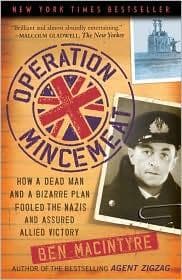
Operation Mincemeat
A true wartime spy story that reads like a thriller: a dead man's planted papers fooled Hitler about where the Allies would strike next.
What It's About
Operation Mincemeat is narrative nonfiction, not a novel, although the category field on this listing says Fiction. Ben Macintyre tells the story of a 1943 British deception plan in which the corpse of a homeless man was dressed as a Royal Marines officer, carried with invented documents, and set adrift off the coast of Spain. The papers were meant to convince German intelligence that the Allies would invade Greece and Sardinia rather than Sicily.
Macintyre builds the account around the people who made it happen: the naval intelligence officers, the forgers, the coroners and spies on several sides, and the rivalries among British services. He draws on archival material and the recollections of those involved, and he keeps the tension high by moving between London, Madrid, and Berlin. The book reads briskly and the chapters are short, so it feels closer to a caper than a dense military history.
The experience is pleasurable and a little surprising. You get a clear sense of how deception was run as an institution, with a mix of ingenuity, paperwork, and luck. Macintyre is less interested in battle tactics than in character and in the strange human details behind a plot that worked on a scale few readers would expect.
Read this if you…
- enjoy true stories of wartime espionage told with novelistic pacing
- want an accessible introduction to Second World War deception operations
- like character-driven history that focuses on people behind official secrets
Skip it if you…
- want a detailed military history of the Sicily campaign or Mediterranean strategy
- prefer a dense, footnote-heavy academic work with extended analysis
Key Ideas
- 1
Deception as a deliberate wartime strategy
The book shows that Allied planners treated misleading the enemy as a formal discipline, not an improvisation. Operation Mincemeat was one piece of a larger effort to shape what German commanders believed, and it depended on understanding how those commanders thought and what they expected to see.
- 2
The importance of believable detail
Much of the plan's success rested on small things: the personal letters, the pocket contents, the ring of a fictional officer. Macintyre explains why these ordinary touches mattered and how planners worked to make an invented life seem real to a suspicious reader on the other side.
- 3
Rivalry and improvisation inside British intelligence
The operation was not a smooth collaboration. Different services competed for credit and control, and the people involved often worked with limited authority. The book describes how bureaucratic friction and personal ambition shaped decisions as much as strategy did.
- 4
Chance and the limits of control
Even a carefully designed plot relies on other people behaving as expected. Macintyre returns to the uncertainty built into the scheme, showing how much hung on whether a few key readers would take the bait, and how little of that could be guaranteed in advance.
Limitations
Macintyre leans on the storytelling conventions of popular narrative history, so some reconstructed scenes and motivations are necessarily interpolated, and readers who want strict documentary caution may notice that. The book is also narrowly focused on one operation, so it says little about the wider intelligence war or the campaign it was meant to support. Some readers find the tone breezy for such serious events. The book is well regarded, but it does not offer deep new analysis of the broader deception program.
Questions Readers Ask
- Is Operation Mincemeat fiction?
- No. It is a work of nonfiction about a real Second World War deception operation carried out by British intelligence in 1943. It reads like a thriller because the events themselves are dramatic, but Macintyre's account is based on historical records and the recollections of those involved.
- Who will enjoy this book most?
- Readers who like spy stories, wartime history, or true crime-adjacent narratives will likely enjoy it most. You don't need prior knowledge of the war, since the book explains the background as it goes and stays focused on the people involved.
- Should I read this before a more detailed history of WWII deception?
- It is a good starting point. It gives you the human story and the logic of the plan quickly, which makes denser works on the wider deception program easier to follow later.
- Published
- 2010
- ISBN
- 9781408809211
- Difficulty
- beginner
- Category
- Fiction
Book details and cover from Google Books.
Ready to read Operation Mincemeat?
Get your copy on Amazon, or listen to it on Audible. We earn a commission if you buy through these links.