
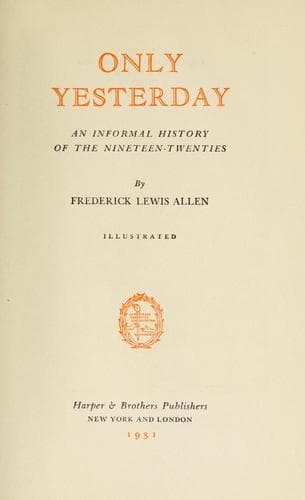
Only yesterday
Frederick Lewis Allen's 1931 social history makes the 1920s feel like a lived mood rather than a list of events, and it remains one of the most readable accounts of the decade.
What It's About
Only Yesterday, published in 1931, is a social history of the United States from the end of the First World War through the 1929 crash. Allen, who edited Harper's Magazine, wrote it for general readers rather than specialists, and he treats the decade less as a set of political events than as a mood: the jittery aftermath of the war, the bright confidence of the boom years, and the moral unease that ran beneath both.
The approach is narrative and topical rather than strictly chronological. Allen moves between politics, business, popular entertainment, changing manners, and the rise of mass consumer habits, letting one thread lead into the next. The prose is brisk and sociable, with the easy authority of someone who lived through the period and wrote about it while it was still close enough to feel vivid.
Reading it feels like being walked through a decade by a knowledgeable companion who keeps asking what ordinary people thought, bought, and feared. It is short, direct, and often wry, and it rewards readers who want to understand how a generation saw itself. Expect a view shaped by its moment of writing, not a modern reassessment.
Read this if you…
- want a vivid, readable overview of American life between the wars
- are curious how ordinary people experienced the boom and the bust
- enjoy classic narrative history written by a contemporary observer
Skip it if you…
- need rigorous, source-heavy academic analysis of the 1920s
- want current research on race, labor, and immigration in that decade
Key Ideas
- 1
A decade defined by mood as much as events
Allen argues the 1920s are best understood through the shifting attitudes of ordinary Americans: disillusion after the war, appetite for novelty, and a sense that old rules no longer applied. He reads politics and economics through these feelings, so public opinion and social habit carry as much weight as legislation or markets.
- 2
Prosperity and the faith in endless growth
Allen traces how the late-decade boom, with rising incomes, installment buying, and a rush into stocks, fostered a belief that prosperity was permanent. He shows how that optimism spread well beyond Wall Street, and why the eventual collapse felt so sudden to those caught in it.
- 3
Consumer culture and the new mass media
Cars, radio, movies, and advertising reshaped daily life and leisure. Allen treats these as forces that changed how people spent their time, what they wanted, and how they measured success, rather than as background decoration on the main story.
- 4
Changing manners and the generational divide
The book looks at shifting attitudes toward dress, courtship, drinking, and independence, especially among younger people, along with the backlash these changes provoked among older and more conservative Americans. The tension between the two camps runs through much of the account.
- 5
Reading the crash as the decade's reckoning
The closing sections connect the speculative excess of the late 1920s to the 1929 crash, presenting it as the moment when the decade's assumptions were tested and found wanting. The ending is more elegiac than triumphant.
Limitations
Written in 1931, the book reflects its moment. It is shaped by the author's own vantage point and the immediate shock of the Depression, so its judgments about prosperity and public taste can feel brisk or dated. Historians have since added much more on race, immigration, labor, rural life, and the experiences of women and Black Americans, which Allen touches on only lightly. Its breadth is also its limit: readers wanting deep analysis of any single event, policy, or region will need other sources.
Questions Readers Ask
- Is Only Yesterday still worth reading today?
- Yes, especially as a view of how the 1920s looked to people living through them. Its coverage is less complete than what modern historians have uncovered, so pair it with newer work for the full picture. Its lasting value is its voice and its sense of atmosphere, which later accounts often flatten.
- How does it compare to more recent histories of the 1920s?
- Newer histories usually cover a wider range of voices, including African American, immigrant, and rural communities, and draw on far more archival research. Allen is narrower in scope but better at conveying how the decade felt, which makes him a good companion to a more comprehensive modern survey.
- Published
- 1931
- Difficulty
- beginner
Book details and cover from Google Books.
Ready to read Only yesterday?
Get your copy on Amazon, or listen to it on Audible. We earn a commission if you buy through these links.