
We earn a commission if you buy through these links. Learn more
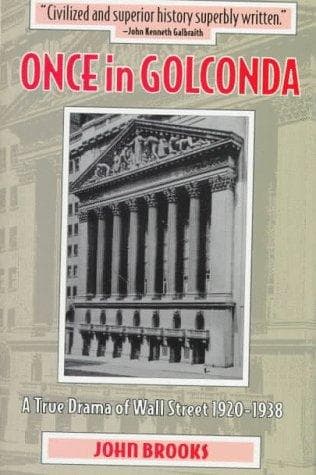
Once in Golconda
by John Brooks
A vivid, well-reported look at how Wall Street's boom, crash, and reform shaped modern finance, told through people and episodes rather than theory.
What It's About
Once in Golconda is a narrative history of Wall Street in the years between the Roaring Twenties and the late 1930s, the stretch that took the market from euphoric speculation through collapse and into a regulatory rebuild. Brooks takes his title from the legendary Indian diamond mine, a shorthand for a place where fortunes lie ready to be picked up, and the image fits the book's interest in how a belief in effortless wealth was built up and then came apart.
The approach is reportorial and character-driven. Brooks moves among bankers, brokers, regulators, and the institutions they ran, using anecdote and period detail to show how decisions looked from the inside at the time. He is less interested in grand economic theory than in how people acted under pressure, how the press and public trust shaped events, and why the old habits of the Street seemed adequate until they were not.
Reading it feels like walking through a well-organized museum of a vanished world: brisk, sociable, sometimes wry, with a steady sense of drama even though the outcome is known. It rewards readers who like journalism with historical depth, and it works well as a companion to later accounts of financial crises because it shows how familiar patterns of excess and reaction have deep roots.
Read this if you…
- want a narrative history of American finance that reads like good journalism
- are curious how the 1929 crash and the New Deal reshaped Wall Street
- enjoy character-driven history with plenty of anecdote and little heavy math
Skip it if you…
- need a rigorous economic explanation of why crashes happen
- want current market analysis or practical guidance for investing today
Key Ideas
- 1
Speculation as a shared belief system
The boom rested on the expectation that prices would keep rising and that ordinary people could join in. Brooks shows how margin buying, easy credit, and confidence among insiders made optimism feel rational, and how hard it was for anyone to be the skeptic while the gains kept coming.
- 2
The crash as a human story
Rather than treating the collapse as a single number on a chart, the book follows its effects on firms, traders, and investors. Panic, reputational damage, and the scramble to protect positions make the crash feel like a series of personal decisions made under extreme stress.
- 3
Reform born from scandal and distrust
Public anger over the abuses of the boom pushed Washington to regulate securities markets for the first time on this scale. The book explores how investigations and new laws changed the Street, and how the resulting rules were both welcomed and resisted by the financial community.
- 4
Reputation as the currency of finance
Banks and exchanges depended on trust, and the book pays close attention to how institutions defended their standing once it was damaged. The theme is that confidence is an asset that can vanish quickly, and that rebuilding it is often as hard as building the business in the first place.
Limitations
Brooks writes from the perspective of a mid-century journalist, so the book reflects the sources and attitudes of its time. Its focus is New York finance and its prominent players rather than ordinary investors, workers, or the wider economy. It is more descriptive than explanatory: it tells you what happened and who was involved more than it weighs competing causes of the crash. Some readers will find the large cast of names hard to track, and later scholarship has added depth on monetary policy and the 1930s economy.
Questions Readers Ask
- Is Once in Golconda still relevant for investors today?
- Its value is mostly historical. Market structure, trading technology, and regulation have changed a great deal since the period it covers, so it will not tell you how to invest. What remains useful is the recurring pattern: confidence that outruns evidence, the temptation of borrowed money, and the scramble for new rules after losses. Readers interested in those themes will find it relevant.
- How does it compare to a standard history of the crash?
- Brooks writes for a general reader and prioritizes narrative and personality over economic analysis. If you want a deeper treatment of monetary causes or the policy debates of the Depression, a scholarly history will serve you better. If you want to feel how the era looked to those living through it, Brooks is an enjoyable place to start.
- Do I need a background in finance to read it?
- No. The story is driven by people rather than formulas, and the financial terms are explained as they come up. A basic sense of what a stock is and what a bank does is enough. Readers who already know the 1929 crash will get more from the detail, while newcomers will still follow the arc.
- Published
- 1969
- ISBN
- 9780393013757
- Difficulty
- intermediate
- Category
- Finance
Book details and cover from Google Books.
Ready to read Once in Golconda?
Get your copy on Amazon, or listen to it on Audible. We earn a commission if you buy through these links.