
We earn a commission if you buy through these links. Learn more
Of Mice and Men
Guide by the Books of the Day editors · Updated · How we write our guides
Steinbeck's short 1937 novella packs a whole theory of friendship, dignity and hard luck into two drifting ranch workers and a dream of owning land.
What Creators Say About Of Mice and Men
2 creators reviewed Of Mice and Men on YouTube between 2011 and 2025, with 49.2K views between them. Their opinions are their own; we picked these reviews, we didn't write them.
What It's About
Of Mice and Men is a short novel, really a novella, about George Milton and Lennie Small, two men who move from one ranch job to the next in California's Salinas Valley during the Great Depression. George is quick and wary; Lennie is huge, gentle, and often unable to grasp the consequences of what he does. Their shared plan, to save enough money for a small place of their own, gives the book its emotional center and its quiet hope.
Steinbeck writes in a spare, plain style, with dialogue that sounds like working men talking and very little interior explanation. The narration rarely stops to tell you what to feel. Instead, the weight comes from repetition, small gestures, and the way the men keep returning to the same talk about the farm they will someday own. The result reads fast, and it stays with you longer than its length suggests.
Reading it is a tense, sad experience, since the story is built around a sense of approaching trouble that the characters can see but cannot escape. It works well as a single sitting. Because Steinbeck later adapted it for the stage, its scenes are clean and theatrical, and many readers find it easy to follow even on a first reading.
Read this if you…
- want a short, emotionally direct novel you can finish in a single sitting
- are interested in Depression-era labor and the lives of migrant workers
- like stories about loyalty where friendship has a real cost
Skip it if you…
- want complex female characters or a broad, many-voiced picture of the period
- are looking for a light read or a book driven by plot twists
Key Ideas
- 1
Companionship as the only real shelter
In a world that offers migrant workers almost no security, George and Lennie have each other. The book treats that bond as both a practical necessity and a source of tenderness. Steinbeck shows how much depends on one person being willing to look out for another, and how fragile that arrangement is when the outside world pushes back.
- 2
The dream of land and what it promises
The plan to own a small piece of land is the book's central image. It gives the men something to talk about each night and a reason to keep going. Steinbeck is interested in the dream as both comfort and blindness, something that sustains people while also making it harder to see the situation they are actually in.
- 3
Loneliness across the bunkhouse
The ranch is full of people set apart by race, sex, age, or status. Crooks, Curley's wife, and the other hands each live in isolation. The book looks closely at how these divisions keep people from helping one another, and how much of the cruelty on the ranch comes from people guarding their own small place in the hierarchy.
- 4
Power, weakness, and who gets blamed
The ranch runs on a clear pecking order, and the people at the bottom absorb the consequences of anything that goes wrong. Steinbeck examines how vulnerability is read as a threat, and how a system with little room for mistakes turns innocent behavior into a problem that someone else must answer for.
- 5
Spare prose doing heavy lifting
The distinctive quality of the book is its restraint. Short sentences, colloquial speech, and an almost documentary calm make the emotional moments land harder. The reader is trusted to notice what is not said, which is why the story feels so compact and so quietly devastating.
Limitations
Curley's wife is seen almost entirely through the men's eyes and has few lines of her own, so readers who want a fully realized female character will find her thin. The language reflects the period and includes racial slurs used by characters, which some readers find hard to encounter. The portrayal of Lennie's disability is dated by modern standards and can read as blunt. The book's tidy structure and sentiment may also feel heavy-handed to readers who prefer ambiguity.
Questions Readers Ask
- Is Of Mice and Men a good first Steinbeck?
- For many readers, yes. It is short, its language is plain, and its themes are easy to grasp. If you find it moving, The Grapes of Wrath is the natural next step, though it is much longer and wider in scope. Readers who want a different tone might try Cannery Row instead.
- Is the book still relevant today?
- Largely yes. Its concerns with precarious work, loneliness, and the limits placed on vulnerable people still resonate, even though the setting is the 1930s. Its language and treatment of disability reflect their era, so readers should approach those parts with that context in mind.
- Published
- 1937
- ISBN
- 9789734664597
- Difficulty
- beginner
- Category
- Fiction
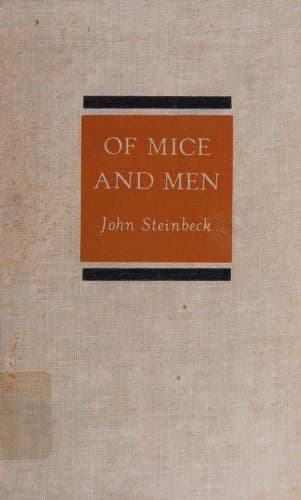
Book details and cover from Google Books.
Ready to read Of Mice and Men?
Get your copy on Amazon, or listen to it on Audible. We earn a commission if you buy through these links.