
We earn a commission if you buy through these links. Learn more
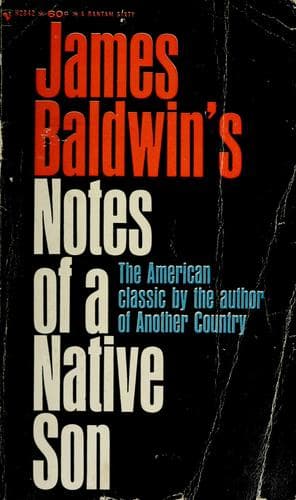
Notes of a Native Son
Baldwin's first essay collection, where anger, family grief, and the question of what it means to be Black and American are examined with unusual precision and nerve.
What It's About
Published in 1955, Notes of a Native Son is James Baldwin's first essay collection. It gathers pieces he wrote in the early 1950s, mostly after he had left the United States for Europe, and it shows a writer working out his position on race, literature, and identity in public.
The book moves between literary criticism and personal memoir. Baldwin takes apart protest fiction, including Uncle Tom's Cabin and Richard Wright's Native Son, arguing that novels built to prove a political point tend to flatten people into symbols. The title essay is more intimate, linking his father's death in the summer of 1943 to the Harlem riot that happened that same week. Other pieces look at what it means to live as an outsider in a small Swiss village and to claim American culture as one's own.
The style is dense, first-person, and argumentative, with long sentences and a moral seriousness that rarely lets up. It is not a tidy narrative. Reading it feels like listening to a sharp mind circle the same painful questions from several angles, and it rewards slow, attentive reading.
Read this if you…
- want an early, influential account of race and identity written from inside the Black American experience
- are interested in how literary criticism and personal memoir can work together
- want to see a writer in his late twenties and early thirties developing the voice that later made him famous
Skip it if you…
- want a straightforward history of civil rights law, policy, or statistics
- prefer narrative pacing, characters, and plot, since this is argument and reflection rather than storytelling
Key Ideas
- 1
Protest fiction can betray its own cause
Baldwin argues that books written mainly to deliver a political message often reduce Black characters to symbols of suffering or of rebellion. He uses Uncle Tom's Cabin and Wright's Native Son to show how this happens even when the intentions are good, and he asks writers to make their characters fully human before making them representatives of anything.
- 2
Inherited bitterness and the struggle against it
In the title essay, Baldwin reflects on his father, a preacher whose hostility toward white people shaped his household. The essay examines how rage can be passed from one generation to the next, and how Baldwin tries to understand that inheritance without simply adopting it or rejecting it outright.
- 3
Race as something carried across borders
The Swiss village essay shows Baldwin discovering that being Black in a community with almost no Black people is not the same as escaping racism. Local curiosity, fear, and admiration reveal how American racial categories travel with him and how his own sense of self is shaped by how others see him.
- 4
Claiming American culture as one's own
Baldwin resists the idea that Black writers are guests in a tradition that belongs to someone else. He treats American language, literature, and history as material he has every right to use, and he frames the search for identity as an act of claiming rather than asking for permission.
Limitations
Many essays respond to specific 1940s and 1950s novels, critics, and debates that modern readers may not know, so some of the argument needs context. The prose is demanding and sometimes repetitive, with the same ideas revisited across pieces. Baldwin's treatment of women and gender here is thin, and some readers find his tone in the criticism combative in ways that can overshadow his points. The collection reflects one writer's viewpoint at one moment in time rather than a survey of Black American thought.
Questions Readers Ask
- Is Notes of a Native Son still worth reading today?
- Yes, especially if you want to see how Baldwin's thinking about race, fear, and identity began. The essays on protest fiction still shape debates about the responsibility of writers, and the title essay remains one of his most admired pieces. Some historical references feel dated, but the core questions are still urgent.
- How does it compare to The Fire Next Time?
- The Fire Next Time, published in 1963, is more focused and urgent, centered on race and the civil rights movement in America. Notes of a Native Son is earlier, more personal, and more literary in its concerns. If you want Baldwin's most direct political writing, start with The Fire Next Time. If you want the roots of his voice, start here.
- Published
- 1955
- ISBN
- 9781299562349
- Difficulty
- intermediate
- Category
- African Americans
Book details and cover from Google Books.
Ready to read Notes of a Native Son?
Get your copy on Amazon, or listen to it on Audible. We earn a commission if you buy through these links.