
We earn a commission if you buy through these links. Learn more
Not a Box
Guide by the Books of the Day editors · Updated · How we write our guides
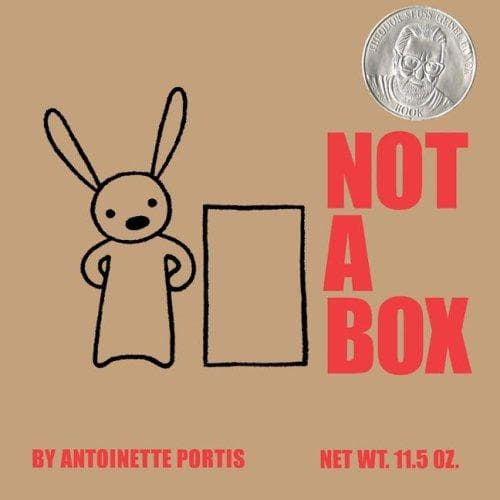
A rabbit insists a cardboard box is not a box, and the joke gives very young children a small, funny lesson in pretend play.
What Creators Say About Not a Box
2 creators reviewed Not a Box on YouTube between 2017 and 2020, with 780.4K views between them. Their opinions are their own; we picked these reviews, we didn't write them.
What It's About
Not a Box is a short picture book for very young children, most often read aloud to toddlers and preschoolers. Its premise is simple: a rabbit is looking at a cardboard box and refuses to call it one. Across the pages, the box keeps turning into other things, each one chosen by the rabbit's imagination rather than by the box itself. The joke is built into the set-up, and the book trusts the reader to be in on it.
The text is spare, with only a few words on most pages, and the repeated insistence gives it a read-aloud rhythm that small children pick up quickly. The illustrations do much of the storytelling. They are plain and uncluttered, and the gap between what the rabbit says and what the picture shows is where much of the humor lives. Nothing here is lush or complicated, which is part of the appeal for a child just learning to follow a story.
Reading it is brief and interactive. A parent or teacher can pause and let a child guess what the box might become next, and the book's logic invites children to offer their own answers. It is less a story with a plot than a small game about pretend play, and adults often find it funnier than expected. Expect a few minutes, not a full sitting.
Read this if you…
- are reading to a toddler or preschooler who likes to join in and call out answers
- want a playful book about pretend play that adults can enjoy too
- are looking for a book that shows how simple objects can become anything
Skip it if you…
- want a story with a plot, characters to follow, or a satisfying arc
- are looking for early reading practice or factual information about boxes or the world
Key Ideas
- 1
Imagination reshapes ordinary objects
The book's central idea is that meaning comes from how we look at things, not from the object itself. A plain box, the most ordinary thing in a house, becomes a starting point for play. The lesson is quiet but clear: everyday materials can hold far more possibility than they first appear to.
- 2
Contradiction as the engine of humor
The rabbit's steady refusal to call the box a box, set against what the pictures show, creates a gap that young readers enjoy spotting. Children tend to correct or join in, which turns the book into a little argument between the text and the child. That tension is what keeps the joke working through repeated readings.
- 3
Minimal text, room for participation
Because the words leave so much open, the reader has space to supply answers, guesses, and reactions. Reading aloud becomes a conversation instead of a recital. This design makes the book suited to children who are not yet reading on their own but who can already take part in a shared game.
- 4
Permission to make believe
Beneath the joke is a gentle message that pretending is a valid and free way to see the world. The rabbit does not need props or permission to imagine. For a young child, seeing that play can be this simple and this unembarrassed may be as valuable as the laugh itself.
Limitations
Its appeal depends on a child's willingness to play along; a child who wants a story with a beginning, middle, and end may find it thin. Parents reading it many times may tire of the single joke. The art is deliberately simple, which some readers find flat next to richer picture books. It is also a very small book, so it offers little for older readers beyond a light reminder about imagination.
Questions Readers Ask
- Who is this book best for?
- It suits children roughly two to six, especially toddlers who are starting to pretend and enjoy repetition. Parents, grandparents, and early-years teachers will find it an easy read-aloud. It works well as a first book about imagination and as a quick, shared laugh. Older children who want a longer story will likely lose interest quickly.
- Is it still relevant, or too simple?
- Its core idea, that a plain box can become anything, is timeless, and the minimal design is part of why it still works with young children. Whether it feels too simple depends on the reader. For its intended audience, the simplicity is the point, and it rewards repeated readings more than a single one.
- Published
- 2006
- ISBN
- 9780061123238
- Difficulty
- beginner
- Category
- Children's Books
Book details and cover from Google Books.
Ready to read Not a Box?
Get your copy on Amazon, or listen to it on Audible. We earn a commission if you buy through these links.