
We earn a commission if you buy through these links. Learn more
Nonviolent Communication
by Marshall B. Rosenberg, Deepak Chopra
Rosenberg's four-part method for speaking and listening without blame is practical, short, and useful the first time you try it in a hard conversation.
What It's About
Nonviolent Communication, usually called NVC, is Marshall Rosenberg's practical framework for talking about conflict without blame, judgment, or coercion. Its core is a four-part sequence: state what you observed without evaluating it, name the feeling it stirred in you, identify the need behind that feeling, and then make a specific, doable request. Rosenberg presents this as a way of listening as much as speaking, so the same structure helps you hear what another person needs underneath their accusations.
The writing is plain and often repetitive, closer to a workshop handout than a literary argument. Rosenberg relies on dialogue examples, short exercises, and lists of feeling and need words, and he returns to the same distinctions many times. Readers looking for research citations or a theory of social change will find little of that. The book is built to be practised, and it rewards slow reading with a notebook or a partner.
Reading it feels less like being argued into a position and more like being trained in a habit. Many readers find the early chapters change how they hear criticism, while the later material on empathy and connection asks for a more sustained commitment. It is short enough to finish in a few sittings, but the real content shows up only when you try the method under pressure.
Read this if you…
- are stuck in arguments with a partner, parent, or coworker that keep repeating the same way
- want a concrete, learnable practice for difficult conversations rather than a big theory
- teach, mediate, or raise children and want shared language for feelings and needs
Skip it if you…
- want an analysis of power, institutions, or systemic injustice, since NVC focuses on interpersonal dialogue
- prefer evidence-heavy books with extensive research citations and statistical support
Key Ideas
- 1
Observation kept separate from evaluation
Rosenberg's first step is describing what happened as something a camera could record, without words like lazy, rude, or unfair. Labels invite defensiveness because the other person hears a verdict rather than information. Much of the early practice is simply noticing when your description has slipped into judgment and rewording it.
- 2
Feelings as signals of unmet needs
The book separates real feelings, such as hurt or relieved, from thoughts dressed up as feelings, such as feeling ignored or feeling that you are being used. Feelings are treated as signals pointing to needs such as respect, rest, or autonomy. Naming the need is what turns a complaint into something the other person can actually respond to.
- 3
Requests that leave room for a no
A request, in Rosenberg's sense, is specific, concrete, and framed as something the other person can do now. A demand carries an implied threat of punishment or guilt if refused. The book argues that requests keep cooperation voluntary, which is why they tend to produce more goodwill over time, even if they are harder to phrase well.
- 4
Empathy before advice or persuasion
Rosenberg asks you to listen for the feelings and needs in the other person's words before offering solutions or defending yourself. He also covers self-empathy, a way of calming yourself enough to think clearly when you are flooded. The emphasis is on connection first, since he argues that people cooperate more readily once they feel heard.
Limitations
Critics say NVC can turn into a script that people recite mechanically, which can sound insincere to the listener. The book has little to say about power imbalances, where asking nicely may not be enough and where a person may face real costs for speaking up. Its prose is repetitive, and some of the terminology and metaphors feel dated or self-consciously therapeutic. The framework also asks a lot of discipline in moments of anger, so many readers find the ideals easier to agree with than to practise.
Questions Readers Ask
- Is Nonviolent Communication still relevant today?
- Yes. The four-part method remains widely used in schools, workplaces, mediation, and family counselling, and it is still taught through certified training. Some of the phrasing and metaphors feel dated, and the book does not engage much with online communication or social media. The core ideas about observation, feelings, needs, and requests hold up well for everyday conflicts.
- How does it compare with Crucial Conversations?
- Crucial Conversations is more focused on high-stakes business and professional dialogue, with tools for keeping discussions safe when emotions run high. Nonviolent Communication is more concerned with empathy and the underlying needs in personal relationships. If your conflicts are mostly at work, the first may fit better. If they are mostly at home, Rosenberg's approach is often more direct.
- Does the Deepak Chopra credit change what I'm getting?
- Rosenberg wrote the main text, and it is his method that the book describes. Some listings credit Deepak Chopra as well, and I cannot confirm the nature of any contribution from him, so check the edition's title page or foreword before buying. The book itself does not rely on Chopra's ideas in any way I can identify.
- Published
- 1999
- ISBN
- 9781892005281
- Difficulty
- beginner
- Category
- Self-Improvement
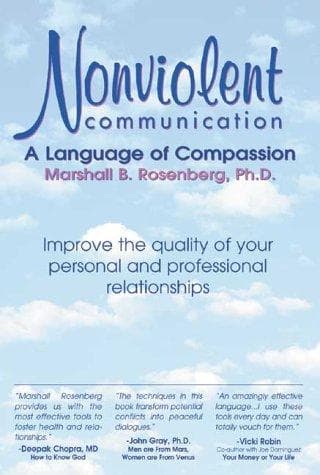
Book details and cover from Google Books.
Ready to read Nonviolent Communication?
Get your copy on Amazon, or listen to it on Audible. We earn a commission if you buy through these links.