
We earn a commission if you buy through these links. Learn more
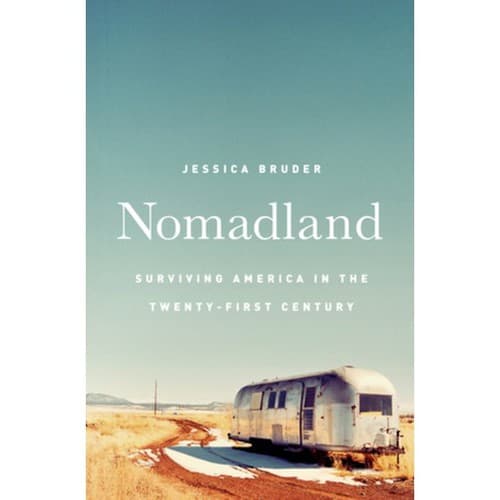
Nomadland
by Jessica Bruder, Harper Audio
On screen: Nomadland (film, 2020)
Guide by the Books of the Day editors · Updated · How we write our guides
A journalist rides alongside older Americans who lost homes and savings in the recession and now live in vans and trailers, turning their precarity into a clear-eyed portrait of work.
What It's About
Jessica Bruder, a journalist, follows a group of mostly older workers who took to the road in RVs, vans, and converted buses after the 2008 crash cost them houses, pensions, or retirement savings they had counted on. The book is reportage rather than a single argument stated up front. It builds its picture through time spent with these people at work sites and on the road, and it has a strong sense of place: the seasonal jobs, the campgrounds, the long drives between them, and the small communities that form among people who keep moving.
The labor at the center is the kind that quietly holds up the wider economy: harvest work, seasonal warehouse jobs, and campground hosting. Bruder shows how these jobs often come with little security, how workers pay for their own travel and housing, and how the whole arrangement can be sold as freedom. She avoids a simple villain or a simple rescue story. Her subjects are often resourceful, funny, and clear about their trade-offs, and the book lets their own accounts carry much of the weight.
Reading it feels like sitting in on a long conversation with people who have less margin than most readers can imagine. The pace is steady rather than thriller-like, and the emotional force builds through accumulation: one bad season, one lost job, one more mile of highway. It is an unsentimental book about aging, debt, and what work means once the old ladder is gone.
Read this if you…
- want an on-the-ground look at how economic shocks reshape ordinary lives
- are interested in labor, retirement security, or the gig and seasonal economy
- prefer narrative journalism that lets people speak for themselves over abstract policy argument
Skip it if you…
- want a tidy policy program or a clear list of solutions to the problems described
- are looking for a lighthearted travel memoir about life on the road
Key Ideas
- 1
Downward mobility after the 2008 crash
The book's starting point is a generation that did things right and still lost its footing. Many of the people Bruder meets had steady careers or owned homes before the financial collapse, and the loss of those anchors pushed them into a life they never planned. The reader comes away seeing homelessness-by-choice as a symptom of a broader failure to protect ordinary savings, not as a personal lifestyle quirk.
- 2
Retirement that many people cannot afford
Bruder challenges the idea that living in a van is a leisure choice for the comfortable. For many subjects, the vehicle is the only housing they can cover on a fixed or shrinking income. The book makes clear how thin the margin is, and how one repair bill, one medical problem, or one slow season can undo months of careful budgeting.
- 3
Freedom and precarity as two sides
Nomadism is presented as both a real source of autonomy and a form of insecurity. Workers value the independence and the ability to leave a place behind, yet they also accept jobs with few protections and unclear futures. Bruder keeps both truths in view, which is what gives the book its tension and keeps it from becoming either a celebration or a condemnation.
- 4
Seasonal labor the economy quietly depends on
A large part of the book describes work that is seasonal, physically demanding, and rarely visible to customers. Bruder examines how employers come to rely on a mobile workforce that absorbs the costs of housing and travel, and how that reliance shapes wages and expectations. Readers who shop online or eat processed food will find the supply chain described here newly concrete.
- 5
Community formed among people in motion
Alongside the economics, the book pays attention to the friendships, mutual help, and informal networks that develop in campgrounds and work camps. These bonds often matter as much to the subjects as the paychecks do. The reader sees how people build a sense of belonging when the usual sources of home and stability have been taken away.
Limitations
The book is built around a relatively small set of people and places, so it cannot represent every worker in the nomadic economy, and some readers will want more systematic data on how widespread this way of life is. Bruder's sympathy for her subjects is evident, which some readers may find shapes the framing more than a colder analysis would. Because it focuses on individual stories and the experience of work, it offers less detail on the policy history of housing, pensions, and labor regulation. The subject matter also reflects conditions in the years around its 2017 publication, so readers should expect some details to have shifted since then.
Questions Readers Ask
- Is Nomadland a novel or nonfiction?
- Nomadland is nonfiction. Jessica Bruder is a journalist, and the book is reportage about real people who live on the road and take seasonal work. It is not the same as the 2020 film based on it, which is a dramatized work. If you want the real people and their own accounts, the book is the place to start, and it reads fluidly without any background in economics.
- Who is this book best for?
- It suits readers who want a grounded account of how economic shocks change everyday life, especially for people approaching or past retirement age. It is also useful for anyone curious about the seasonal and gig labor that sits behind many goods and services. Readers looking for a clear policy agenda may find it too observational, since the book focuses on experience more than prescriptions.
- Published
- 2017
- ISBN
- 9788381912174
- Difficulty
- beginner
- Category
- Business
Book details and cover from Google Books.
Ready to read Nomadland?
Get your copy on Amazon, or listen to it on Audible. We earn a commission if you buy through these links.