
We earn a commission if you buy through these links. Learn more
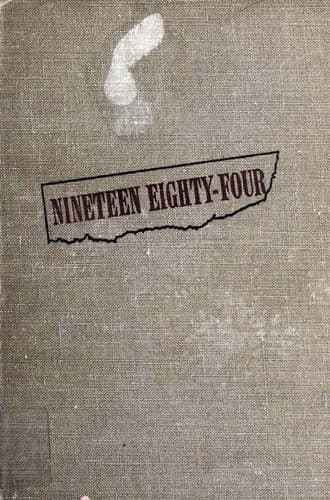
Nineteen Eighty-Four
A short, bleak novel that shows how power can rewrite the past, shape language, and wear down private life, and it still reads as a sharp warning decades later.
What It's About
Nineteen Eighty-Four is a novel, not a work of history, although the category here files it under history. Orwell wrote it in the years after the Second World War, drawing on the totalitarian states he had watched rise and the propaganda machinery of his time. The story follows Winston Smith, a minor clerk in a state that controls public and private life, whose job is to revise the historical record so it matches whatever the ruling Party declares to be true today.
Orwell's style is plain and tightly controlled, and the reading experience is claustrophobic by design. Much of the book stays close to Winston's thoughts, so you feel the strain of constant caution and the fear of being observed in a world where the walls themselves can watch. Some sections are deliberately expository, including a long political treatise and an appendix on the official language. They slow the pace, but they are central to the book's argument about how power sustains itself.
Reading it now is less like encountering a prediction and more like reading an argument about a type of state and the everyday compromises that keep it standing. It rewards slow reading, and a second pass often reveals how much of its unease comes from small details rather than spectacle. Expect a grim, unsettling book rather than an escape.
Read this if you…
- want a classic that explores how governments use information and language to control people
- are interested in the mechanics of propaganda, censorship, and political doublespeak
- prefer bleak, morally serious fiction that asks you to think after you finish it
Skip it if you…
- need uplifting stories or a hopeful ending to enjoy a book
- want a fast, plot-driven thriller, since long political passages slow the middle
Key Ideas
- 1
Control over the past as well as the present
The novel's central unsettling idea is that a regime which controls records can control memory itself. Winston's work shows how easily facts can be altered, and how a population that cannot check the past has no firm ground from which to judge the present. Orwell makes this feel routine and bureaucratic rather than dramatic, which is part of why it lingers.
- 2
Surveillance that makes privacy impossible
The state watches through devices built into homes and workplaces, leaving almost no room to be alone. The book is less interested in gadgetry than in what constant observation does to the mind. It shows people policing their own faces, gestures, and thoughts, so the watching becomes internal long before anyone is punished for it.
- 3
Language designed to narrow thought
The official language is being engineered to make dissent harder to express, by shrinking vocabulary and removing words for rebellion. The appendix explains this project in a matter-of-fact tone. Orwell's point is that thought depends on words, and that controlling words is a practical way of limiting what people can even imagine.
- 4
Ordinary people and the cost of compliance
Much of the book's tension comes from its ordinary characters, who are neither heroes nor villains but people trying to get through the day safely. Their small betrayals, rationalizations, and private hopes show how a system survives through everyday cooperation. Readers often find these moments more disturbing than the more dramatic scenes of state violence.
Limitations
Some readers find the characters thin, with Winston and Julia serving more as vehicles for ideas than as fully developed people. The long expository sections, including the book within the book and the appendix, can feel like lectures and interrupt the narrative momentum. The specific political landscape Orwell had in mind, with its wartime alliances and rival superpowers, is dated, and some readers feel the book's predictions about technology were less precise than its psychology. Its portrayal of women has also drawn criticism.
Questions Readers Ask
- Is Nineteen Eighty-Four history or fiction?
- It is fiction. Orwell wrote a dystopian novel set in an imagined future year, and it is not a historical account of any real period. It is often shelved alongside history because it draws directly on the politics of the 1930s and 1940s, including totalitarian regimes and wartime propaganda, so readers interested in that background will find it useful context.
- Is it still relevant today?
- Many readers say yes, especially for its ideas about surveillance, manipulated information, and the way language can be bent for political ends. Some of its specific details feel dated, but the core questions about truth and power remain widely discussed. It works best read as a study of how these tendencies operate rather than as a literal forecast.
- Published
- 1949
- ISBN
- 9781472133038
- Difficulty
- intermediate
- Category
- History
Book details and cover from Google Books.
Ready to read Nineteen Eighty-Four?
Get your copy on Amazon, or listen to it on Audible. We earn a commission if you buy through these links.