
We earn a commission if you buy through these links. Learn more
Nightwood
by Djuna Barnes
A modernist novel of lyrical darkness and restless desire, where Djuna Barnes trades plot for feverish, incantatory prose; worth reading for its language, rewarding for patient readers.
What It's About
Nightwood, published in 1936 with an introduction by T. S. Eliot, follows a group of restless figures drifting through Paris and beyond in the years between the wars. Its center of gravity is a loose circle of lovers, outcasts and aristocratic hangers-on, bound together by desire, loss and a shared sense of being out of step with ordinary life. Barnes does not build the book around events so much as around moods, portraits and long, looping conversations.
The style is the main event. Sentences swell, double back, pile up imagery and sometimes stall into near-incantation. The book's most famous passages are monologues delivered by a late-night doctor who talks about sin, God, the body and the human need for company. Readers used to tight narrative momentum will find the pace slow and the syntax demanding, and the characters speak as much in arias as in conversation.
Reading it is less like following a story than sitting in a dim room while someone speaks in fevers. The experience is haunting and sometimes funny, with the darkness leavened by sharp wit. It rewards rereading and slow attention, and many readers find that its imagery stays with them longer than its plot, since there is little plot to remember.
Read this if you…
- enjoy modernist prose and are willing to slow down for dense, ornate sentences
- are interested in queer literary history and the bohemian world of interwar Paris and New York
- want a novel that works more like a poem or a painting than a conventional story
Skip it if you…
- want a clear storyline, steady momentum and a satisfying sense of progress
- find heavily stylized dialogue tiring rather than immersive
Key Ideas
- 1
Language as the real engine
Barnes writes in a dense, ornate, almost baroque style that prizes sound, rhythm and image over clarity. Meaning often arrives sideways, through accumulation rather than explanation. The book works best when you stop trying to extract a plot and let the sentences do their own slow work on you.
- 2
Love as a wound rather than a rescue
The central relationships are marked by longing that cannot be satisfied and by partners who cannot truly reach one another. Barnes treats desire, especially between women, as something that exposes people rather than saves them. The tenderness here is closely tangled with cruelty, betrayal and a kind of exhausted tenderness.
- 3
The night as a space of unreason
Night in the novel is a setting, a mood and a moral territory. The doctor's long nocturnal monologues wander across religion, illness, sexuality and the body, offering a kind of wounded philosophy. These passages are where the book most clearly argues that ordinary daylight order is a thin cover over deeper, stranger impulses.
- 4
Displacement and the search for belonging
Many characters are exiles, déclassé aristocrats or people who never quite fit the nations and communities they come from. Barnes uses this uprootedness to examine identity, performance and the desire to be accepted. The sense of people wearing inherited roles that no longer fit runs through the whole book.
Limitations
Nightwood can feel overwrought, and its style is so insistent that some readers find it airless or self-regarding. Its plot is loose, and characters sometimes seem to function more as mouthpieces or symbols than as people. Some portrayals, particularly of Jewish figures, draw on period stereotypes that readers will want to weigh as they read. The book also does not offer much of a social or political argument; its concerns are mostly emotional, aesthetic and metaphysical.
Questions Readers Ask
- Is Nightwood still worth reading today?
- Yes, especially if you care about modernist experiments with language or about early queer writing. It remains influential among novelists and poets. Its prose is unlike most contemporary fiction, so it works well as a deliberate change of pace rather than a casual read.
- How does Nightwood compare to Virginia Woolf?
- Woolf is luminous and psychologically precise, while Barnes is darker, more baroque and more theatrical. If you enjoy Mrs Dalloway but want something stranger and more intense, Nightwood is a logical next step. Expect less clarity and more incantation.
- Should I read Eliot's introduction first?
- You can, but it is not required. Eliot's introduction is brief and famously idiosyncratic, and many readers find it more useful after finishing the novel. Reading it afterward can make his claims about the book's tone and characters easier to test against your own response.
- Published
- 1936
- ISBN
- 9780811216715
- Difficulty
- advanced
- Category
- Fiction
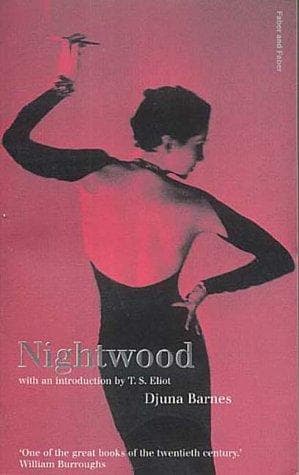
Book details and cover from Google Books.
Ready to read Nightwood?
Get your copy on Amazon, or listen to it on Audible. We earn a commission if you buy through these links.