
We earn a commission if you buy through these links. Learn more
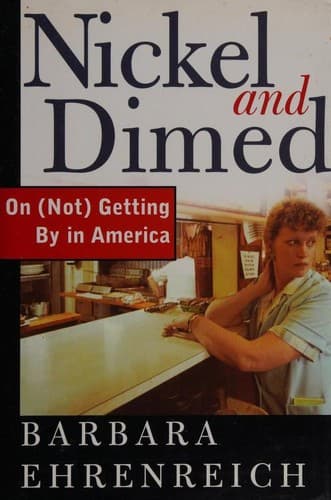
Nickel and Dimed
Guide by the Books of the Day editors · Updated · How we write our guides
Barbara Ehrenreich's firsthand account of trying to pay rent and bills on entry-level wages is sharp, funny, and still one of the clearest looks at American low-wage work.
What Creators Say About Nickel and Dimed
2 creators reviewed Nickel and Dimed on YouTube between 2015 and 2023, with 13.5K views between them. Their opinions are their own; we picked these reviews, we didn't write them.
What It's About
Nickel and Dimed is Barbara Ehrenreich's 2001 book about what it takes to get by on low-wage work in the United States. Although this site files it under Tech, it has nothing to do with technology. It is reported nonfiction about jobs and budgets. Ehrenreich, a journalist, took entry-level positions in several towns, including waitressing, hotel housekeeping, nursing-home work and retail, and tried to cover her rent and bills on what she earned.
The approach is participant observation rather than statistics. Ehrenreich tracks her wages, her housing searches, her transportation problems and her health, and the book reads as a sequence of small, concrete problems: security deposits, first-month costs, and a car that matters more than anything else. The tone is wry and direct, and the prose moves quickly, so the hard material rarely feels preachy.
Reading it feels less like studying poverty from a distance and more like sharing a budget with someone who keeps running out of money. You come away with a sharper sense of how little margin many workers have, and how much of their labor is invisible to people who never do it.
Read this if you…
- want a grounded look at economic inequality from firsthand experience
- are curious how entry-level work actually pays out in day-to-day life
- prefer narrative reporting to dense policy analysis
Skip it if you…
- want statistics-driven analysis of wage policy or poverty data
- are looking for a book about technology, which this is not
Key Ideas
- 1
Low wages as a math problem
Ehrenreich's central point is arithmetic. Once rent, food, transport and phone costs are added to a wage near the legal minimum, there is often little or nothing left over. The book shows how a worker who does everything right can still fall behind, which reframes poverty as a structural issue rather than a matter of personal discipline.
- 2
The hidden costs of getting hired
Many jobs demand money up front for uniforms, background checks, deposits and transportation before the first paycheck arrives. Ehrenreich documents how these costs fall hardest on people with the least savings, and how a new job can turn into a debt trap before it becomes a source of income.
- 3
Why housing is harder than finding work
Ehrenreich finds that jobs were often easier to get than a place to live. Motels, deposits and weekly rents can consume most of a paycheck, and the book makes the case that housing costs, more than hourly pay, decide whether a low-wage worker can stabilize.
- 4
The dignity and invisibility of service work
Through the eyes of a waitress, housekeeper and aide, the book explores how physically demanding, closely supervised work is undervalued by the customers and managers who depend on it. It is as much about respect and the social texture of work as it is about money.
Limitations
Critics have pointed out that Ehrenreich's experiment was short and self-selected. She had a car, some savings, no dependents, and the option to leave at any time, which many low-wage workers do not have. Her broader conclusions rest on a handful of jobs in a few places, so the book is more persuasive as reporting than as a representative study. Wages, rents and benefits have shifted since the late 1990s, so the specific figures are dated, though the core dynamics remain widely discussed.
Questions Readers Ask
- Is Nickel and Dimed a tech book?
- No. Although this site lists it under Tech, the book is about low-wage work and household budgeting in the United States. It contains no technology analysis. If you want a book about the tech industry, you will need to look elsewhere on the site.
- Is Nickel and Dimed still relevant?
- Yes, in its core argument. The specific wages and rents are dated, but the basic problem of costs outpacing entry-level pay, and the upfront costs of starting a job, are still central to debates about low-wage work.
- How does it compare to Evicted by Matthew Desmond?
- Evicted is more sociological, following several families in Milwaukee over time and drawing on extensive field research. Nickel and Dimed is more personal and experimental, built around one author's own attempts to make ends meet. Readers often find the two complement each other well.
- Published
- 2001
- ISBN
- 9780805080278
- Difficulty
- beginner
- Category
- Tech
Book details and cover from Google Books.
Ready to read Nickel and Dimed?
Get your copy on Amazon, or listen to it on Audible. We earn a commission if you buy through these links.