
We earn a commission if you buy through these links. Learn more
New Kid
by Jerry Craft
Guide by the Books of the Day editors · Updated · How we write our guides
Jerry Craft's Newbery-winning graphic novel follows a seventh grader's scholarship to a wealthy private school, offering a funny look at race, belonging, and being the only one in the room.
What Creators Say About New Kid
2 creators reviewed New Kid on YouTube between 2019 and 2020, with 144.9K views between them. Their opinions are their own; we picked these reviews, we didn't write them.
What It's About
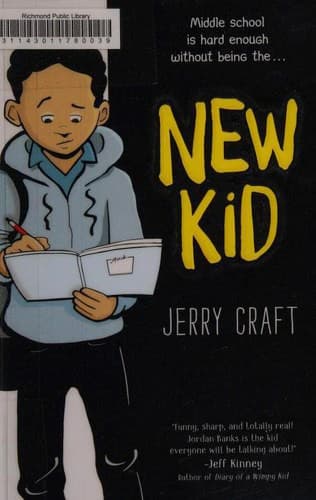
New Kid follows Jordan Banks, a talented young artist who leaves his neighborhood in upper Manhattan for a scholarship at Riverdale Academy Day School, a private school where most of his classmates come from much wealthier families than his own. Jordan loves drawing comics and spends a lot of the book sketching his way through his confusion, so the story is told largely in panels, with his own doodles and imagined comic strips sitting alongside the main narrative. That mix makes it feel quick and playful, even when the subject is heavy.
The book is written for middle-grade readers, and it reads in one or two sittings. Craft keeps the tone light and observant: Jordan's humor and sharp eye for hypocrisy carry most scenes, and the awkward moments of school life, like being mistaken for someone else or being asked to speak for an entire group, land with real specificity. The emotional core is a boy trying to hold onto who he is while learning to move between two very different worlds.
Reading it feels like sitting with a kid who is working out what he thinks in real time. It is warm and funny, but it does not rush past the discomfort. Adults who have ever felt out of place will recognize a lot here, and younger readers will find a character who is funny, honest, and easy to root for.
Read this if you…
- want a funny, fast graphic novel that still deals honestly with race and class
- are a parent, teacher, or librarian looking for a book to start a conversation with a middle-grade reader
- enjoyed stories about a kid figuring out where he fits, like those with a strong comics or art thread
Skip it if you…
- want a long, dense novel with complicated plotting or a lot of adult-level detail
- are looking for a book that resolves its social questions neatly with a clear message
Key Ideas
- 1
Being the only one in the room
Much of the book looks at what it is like to be one of a few Black students at a school where the norms, jokes, and assumptions come from someone else. Craft shows how small comments and well-meaning questions can add up, and how a kid can feel pressure to represent everyone who looks like him.
- 2
Code-switching between two worlds
Jordan adjusts how he talks, dresses, and acts depending on whether he is at school or home. The book treats this as a practical skill he is forced to learn, and it asks whether the cost of constantly adapting is worth what he gains.
- 3
Friendship that is tested by difference
Jordan's friendships at school are central, and they are not simple. The story takes seriously how friends can care about each other and still miss what the other person is living through, and how honesty can be uncomfortable for everyone involved.
- 4
Art as a way of processing
Jordan's sketchbook and comics are both a theme and a formal device. Drawing gives him a private space to notice and name what bothers him, and the way the book folds those drawings into the story is a big part of why it feels distinctive.
- 5
Identity without a neat answer
The book does not offer one correct way to be Black at a privileged school. Jordan tries different approaches, makes mistakes, and keeps working out who he wants to be, which makes the ending feel open rather than tidy.
Limitations
Some readers find the book's tone a little tidy, with conflicts that are resolved more quickly than real life would allow. Its portrayal of the private school can lean on familiar types, and adult readers may wish for more depth in some supporting characters. Because it is written for young readers, it simplifies some of the racial and economic dynamics it describes. It is a starting point rather than a complete study of these issues.
Questions Readers Ask
- Is New Kid suitable for adults, or only for middle-grade readers?
- It is written for middle-grade readers, but many adults enjoy it, especially those who have felt out of place in a school or workplace. The humor and art are strong, and the emotional honesty works at any age. Adults looking for more complexity may want to pair it with longer novels on the same themes.
- How does New Kid compare to other graphic novels about school and identity?
- New Kid is closer to a realistic school story than to fantasy-driven graphic novels. Its strength is the way it blends comic panels, sketches, and everyday scenes, so the reader feels Jordan's point of view directly. If you liked it, look for other graphic memoirs and novels that use art as a way for a young narrator to make sense of his world.
- Published
- 2019
- ISBN
- 9780062691194
- Difficulty
- beginner
- Category
- Fiction
Book details and cover from Google Books.
Ready to read New Kid?
Get your copy on Amazon, or listen to it on Audible. We earn a commission if you buy through these links.