
We earn a commission if you buy through these links. Learn more
Native Son
by Richard Wright, Richard Wright - undifferentiated
Guide by the Books of the Day editors · Updated · How we write our guides
Richard Wright's 1940 novel shows how a young Black man's fear and anger are shaped by the city that confines him, and it remains a hard, essential read on race.
What It's About
Native Son follows Bigger Thomas, a young Black man in 1930s Chicago who lives with his family in a single cramped room and sees few paths out of poverty. He takes a job as a chauffeur for a wealthy white family, and a night of panic and bad decisions sets off a chain of events the rest of the novel must reckon with. It is less a whodunit than a study of how a person arrives at a terrible moment.
Wright writes in close third person and stays inside Bigger's head, so you experience his fear, resentment and brief flashes of exhilaration rather than watching him from a distance. The prose is blunt and sometimes repetitive. The middle section is a fast chase that reads almost like a thriller, while the later sections shift into long passages of argument, especially at the trial, where ideas take over from action.
Reading it is uncomfortable, and that discomfort is the point. Wright does not make Bigger easy to like, and he refuses to let you settle into simple pity or simple condemnation. The book asks you to stay with a character you may not want to understand and to notice how the world around him shaped nearly every choice he makes.
Read this if you…
- want a novel that treats race and class as the structure of an American city rather than background scenery
- can handle a bleak, angry narrator and want to be pushed well outside your comfort zone
- are interested in how mid-century American fiction shaped later conversations about race and justice
Skip it if you…
- need a sympathetic protagonist or a story with a hopeful arc
- find long political speeches a dealbreaker in fiction
Key Ideas
- 1
Fear as the engine of Bigger's life
Fear runs through the novel as a constant pressure. Bigger has learned to be wary of every white person he meets, and that wariness makes him cautious in some moments and reckless in others. Wright uses fear to show how a whole life can be organized around avoiding humiliation and danger, and how that same fear can turn into violence when it finally breaks.
- 2
Racism as a system, not just cruelty
The Daltons are not openly hostile, and their charity and good intentions still keep Bigger boxed in. Wright shows racism operating through housing, jobs, schooling and the unspoken rules of a segregated city. The point is that a person can be harmed by a structure even when no single character intends harm in the way Bigger fears it.
- 3
Violence and the question of freedom
After the crime, Bigger feels a strange sense of control he has never had before. Wright does not present this as a simple triumph or a simple tragedy. The book keeps asking whether such a moment can be a form of agency when it is produced by a society that has denied a person every other kind, and it leaves that question open.
- 4
The trial as a debate over responsibility
The courtroom section turns the novel into an argument about who is to blame for what happened. The lawyer's long speech places social conditions at the center of the case. Some readers find this the most powerful part of the book, and others find it the place where the story becomes most like an essay. Either reaction tells you something about the novel.
Limitations
Some readers find the later sections, especially the trial speeches, heavy-handed and didactic, with characters who serve as mouthpieces for ideas. Bigger is sometimes read more as a symbol than as a fully rounded person. The women in the book, particularly Bessie, are thinly drawn, and their portrayal is often criticized. Because the novel was written in 1940, its vocabulary and some of its assumptions feel dated, and its Chicago is a historical setting rather than a contemporary one.
Questions Readers Ask
- Is Native Son still relevant today?
- Yes. Its questions about policing, segregated housing and who gets blamed for crime remain in public debate. The specific Chicago of the 1930s is historical, but Wright's account of how a city can shape a young man's choices still reads as pointed. Expect some dated language and attitudes along the way.
- How does it compare to Invisible Man?
- Both are mid-century novels by Black American writers about being trapped by a society that refuses to see you. Invisible Man is more allegorical and surreal, while Native Son is rooted in a realistic city and a crime story. Readers who admire one often find the other rewarding for different reasons.
- Is it suitable for high school readers?
- Many schools teach it, but the novel includes graphic violence, sexual content and racial slurs. It suits mature teen readers, especially with a teacher or a parent to discuss its themes. Adults who want a demanding, direct introduction to its ideas will find it accessible.
- Published
- 1940
- ISBN
- 9780060830557
- Difficulty
- intermediate
- Category
- Fiction
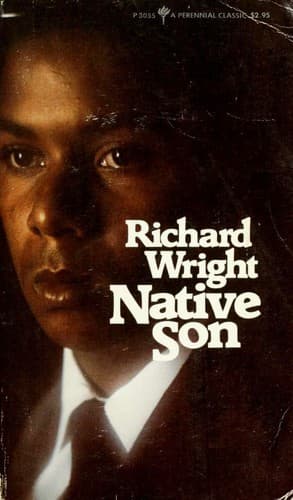
Book details and cover from Google Books.
Ready to read Native Son?
Get your copy on Amazon, or listen to it on Audible. We earn a commission if you buy through these links.