
We earn a commission if you buy through these links. Learn more
Naked Lunch
by William S. Burroughs, William Burroughs
A hallucinatory, deliberately fragmented satire of addiction, control and American appetite, Naked Lunch rewards readers willing to give up the expectation of a conventional story.
What It's About
Naked Lunch, first published in Paris in 1959 and in the United States in 1962, is not a novel in the usual sense. Its narrator, Lee, is a heroin user drifting through Interzone, a fictional port city loosely modeled on Tangier. The book is built from short, self-contained sections, often called routines, that jump between drug withdrawal, grotesque medical experiments, sexual violence and bureaucratic absurdity.
The style is the main event. Sentences are hard, clipped and often cold, and the humor arrives without warning, sometimes in the middle of something horrifying. Burroughs used cut-up methods to assemble much of the material, so the text has a collage quality: images recur, characters mutate and reappear, and the logic is dreamlike rather than causal. Reading it feels less like following a plot than sitting through a fever.
Expect to put it down often. The book works best as a series of intense scenes rather than a single arc, and it rewards rereading. If you want characters who grow or a clear destination, you will be frustrated. The disorientation is deliberate: it mirrors the experience of addiction and of living under systems that never explain themselves.
Read this if you…
- enjoy experimental fiction where language, mood and collage matter more than plot
- are curious about the literary side of the Beat movement and its concerns with drugs and social control
- want a book that disturbs and provokes you rather than simply entertaining you
Skip it if you…
- need a clear plot, consistent characters or a satisfying ending
- find graphic violence, sexual content or detailed drug use hard to sit with, even when it serves a satirical purpose
Key Ideas
- 1
Addiction as a total condition
Junk is not just a subject here but a lens on everything else. Need organizes relationships, money, travel and the body itself. Burroughs presents dependence as a kind of economy in which every desire is bargained for and every choice is shaped by the next fix, which is why the book reads as both personal and systemic.
- 2
Control systems and the medical state
Doctors, police, governments and institutions appear as overlapping machines that treat people as material to be processed. Dr. Benway, the book's best-known figure, embodies a cheerful, amoral expertise. The satire targets authority that justifies cruelty in the name of order, health or progress, and it still lands because the mechanisms it describes are recognizable.
- 3
Fragmentation as a literary method
The cut-up approach breaks narrative into pieces that can be shuffled, repeated and recombined. Because the sections can be read in several orders, the book resists a single authoritative shape. Readers who expect continuity may feel lost, but the fragments create a cumulative pressure that a linear telling could not produce.
- 4
Satire without comfort
The book's humor is bleak, sudden and frequently obscene. It mocks American consumer appetite, Cold War paranoia and the moral pretensions of respectable society, but it refuses to offer a redemptive reading. The laughter tends to curdle, which is part of why the book provoked obscenity trials and still divides readers.
Limitations
The most common criticisms concern sexual violence and misogyny, which are depicted with little distance and women are largely peripheral. Some readers find the satire of drugs and bureaucracy repetitive over the length of the book, and the uneven quality of the cut-up material means some sections feel like padding. Its references to 1950s expatriate life, drug culture and Cold War anxieties may also need footnotes for readers without that background.
Questions Readers Ask
- Where should I start with Burroughs?
- Many readers begin with Junk, published in 1953 under a pseudonym and far more conventional in structure. It gives you Burroughs's experience of addiction in a straightforward narrative, which makes Naked Lunch's fragmented method easier to appreciate when you reach it. Going in cold is possible, but the earlier book works well as a preface.
- Does the order of the sections matter?
- Less than most novels. The sections are designed to be read in an order that is not strictly fixed, and many readers dip in and out or reread favorite passages. Some editions present a particular sequence, but you should not feel obliged to follow it. Treat the book as a set of linked pressures rather than a story to finish in one direction.
- Is Naked Lunch still relevant today?
- Yes, particularly its satire of institutions that treat people as data and its portrait of dependence as a system. Its explicit content and period references can feel dated, but the critique of authority and consumption remains sharp. Readers interested in how postwar writers challenged censorship and narrative convention will find it especially rewarding.
- Published
- 1959
- ISBN
- 9780802119261
- Difficulty
- advanced
- Category
- Fiction
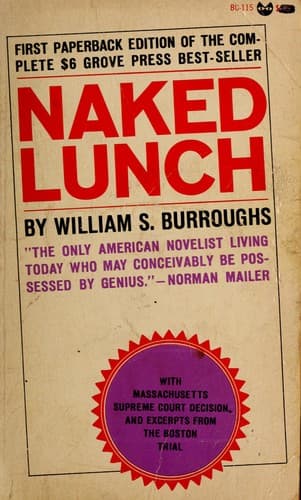
Book details and cover from Google Books.
Ready to read Naked Lunch?
Get your copy on Amazon, or listen to it on Audible. We earn a commission if you buy through these links.