
We earn a commission if you buy through these links. Learn more
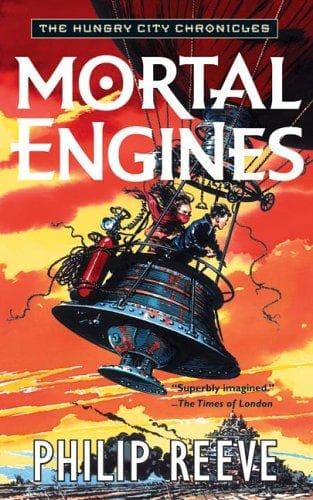
Mortal Engines (The Hungry City Chronicles)
by Philip Reeve
Philip Reeve's Mortal Engines imagines London as a city on wheels that hunts smaller towns, and it delivers fast, inventive adventure with a darker edge than most children's fiction.
What It's About
Mortal Engines is a young adult-leaning adventure set in a far future where a catastrophic war has wrecked the world and cities have learned to move. London now runs on enormous wheels and hunts smaller towns across a ruined landscape, devouring them for their machinery and their people. The story follows Tom Natsworthy, a junior apprentice historian, and Hester Shaw, a scarred young woman with a grudge, after an accident throws them out of the city.
Reeve's approach is quick and cinematic. Chapters move briskly, the action is frequent and loud, and the world is built through odd, concrete details: grimy machinery, street-level scavenging, and a society that treats the past as something to be dug up and sold. The tone mixes adventure with dark humour and the occasional tender moment. Reading it feels like watching a steampunk-flavoured chase unfold, with a lot of invention packed into every scene.
It rewards readers who enjoy spectacle more than slow character study. Expect violence, a restless pace, and a world that keeps changing under you. It is the first book in a quartet, so it works as a complete opening, but its larger threads are left open for the sequels.
Read this if you…
- want a fast, imaginative adventure with steampunk machinery and a world that feels genuinely strange
- enjoy dark, violent young adult fiction with dry humour and a strong sense of spectacle
- are curious about post-apocalyptic stories that treat cities themselves as characters
Skip it if you…
- prefer slow, character-driven literary fiction with lengthy interior reflection
- find graphic violence or constant peril hard to enjoy, even in a fantasy setting
Key Ideas
- 1
Cities that hunt other cities
The book's central conceit is that the strongest towns have become predators. Larger mobile cities consume smaller ones, and the ecological logic of eat-or-be-eaten shapes politics, economics, and daily life. Reeve pushes this idea to its grim conclusions, so the world feels less like a backdrop and more like a system with its own cruel rules that the characters must understand to survive.
- 2
History as a scavenged commodity
Tom's training as a historian places the past at the heart of the story. In this world, old artefacts are treasure to be excavated, traded, and sometimes misused. The book asks what a culture gains and loses when it treats its history as salvage, and it gives the reader a sharp sense of how easily knowledge can be turned into a means of power.
- 3
Class and the outsider
London's privileged citizens sit atop a rigid hierarchy, while people in smaller settlements and the wild lands beyond are regarded as expendable. The divide between those inside the city and those outside it drives much of the plot and gives the adventure a clear moral direction, though the picture is drawn in broad strokes rather than nuance.
- 4
Damaged heroes and the cost of revenge
Hester's bitterness and physical scars make her one of the more memorable figures in the book. Her desire for vengeance pushes the story forward, and Reeve is willing to let her be unlikeable at times. Tom's wide-eyed idealism offers a counterweight, and the friction between them gives the adventure an emotional spine.
Limitations
Some readers find the characterisation thin, especially among secondary figures, who often serve the plot more than they develop as people. The world's politics are sketched in broad, sometimes simplistic terms, and the moral contrast between city and outsider can feel schematic. The pace favours momentum over texture, so readers who want a slowly unfolding world may find the book breezy. Its violence is frank, which suits some young readers but not all.
Questions Readers Ask
- Is Mortal Engines suitable for adults or just children?
- Yes, many adults enjoy it. It is written for younger readers, so the prose is direct and the chapters are short, but the violence, dark themes, and inventive world make it appealing to grown-ups who like fast adventure. Readers who enjoy young adult fiction or steampunk will likely find it rewarding without feeling it is beneath them.
- Do I need to read the whole Hungry City Chronicles series?
- The first book stands alone as a complete adventure, but it ends with larger questions open. If you enjoy the setting and characters, the sequels develop the world further. If you only want a single satisfying story, you can stop after this volume without feeling that something essential is missing.
- What should I read if I like Mortal Engines?
- If you want another inventive world built around unusual machinery and bold storytelling, Philip Pullman's His Dark Materials is a natural next step, since it also mixes adventure with big ideas. For a more grown-up post-apocalyptic take, consider Cormac McCarthy's The Road, which is far bleaker and quieter.
- Published
- 2004
- ISBN
- 9780060082093
- Difficulty
- beginner
- Category
- Children's Books
Book details and cover from Google Books.
Ready to read Mortal Engines (The Hungry City Chronicles)?
Get your copy on Amazon, or listen to it on Audible. We earn a commission if you buy through these links.