
We earn a commission if you buy through these links. Learn more
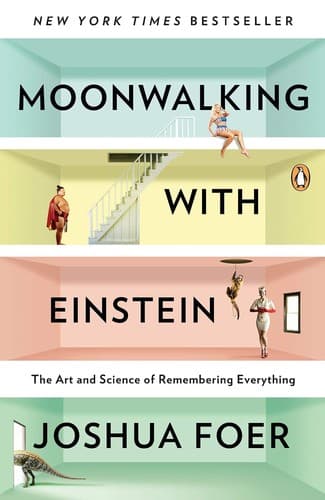
Moonwalking with Einstein
by Joshua Foer, Mike Chamberlain (Narrator) Joshua Foer
Guide by the Books of the Day editors · Updated · How we write our guides
A journalist who set out to cover the U.S. Memory Championship ends up training for it, and the result is a lively mix of personal experiment, memory history, and popular science.
What It's About
Joshua Foer, a science journalist, went to the U.S. Memory Championship in 2005 to write about it and ended up learning its techniques himself. Under the guidance of competitive memorizers, he took up the method of loci, an ancient practice of attaching images to places in an imagined space, and within a year he had won the national title. The book grows out of that experience but does not stay inside it.
From there Foer widens the frame. He traces the long history of memory arts, from classical orators and medieval memory palaces to the performers who turned recall into a stage act, and he brings in what cognitive science says about how memory works and why everyday recall is so unreliable. The result is part reportage, part history, and part popular science, with the author as a curious and self-deprecating guide.
Reading it feels more like a conversational tour than a textbook. Foer is funny about his own struggles and skeptical of grand claims, so the book is at its best when it lets you weigh the ideas alongside him. You finish with a clearer sense of what memory is for, and with the impression that the mind is both more inventive and more fragile than we usually assume.
Read this if you…
- are curious about how memory works and want an accessible, story-driven explanation
- enjoy history of ideas and want to see how older cultures handled knowledge without books
- want to understand the mechanics of a memory technique well enough to consider trying it
Skip it if you…
- want a rigorous, citation-heavy account of memory science or a clinical view of memory disorders
- are looking for a how-to manual with step-by-step exercises rather than a narrative
Key Ideas
- 1
Memory is a trainable skill
Foer's central surprise is that the people who remember enormous amounts are often not gifted with unusual brains. They have learned systems that turn abstract information into vivid, ordered images. The book takes this seriously, showing how deliberate practice and specific techniques can produce results that look like talent from the outside.
- 2
The method of loci as a mental tool
The ancient technique of placing images along a familiar route or room is the book's main thread. Foer explains why the approach works, since it leans on spatial and visual memory that people already have, and he shows how it gets used in competition. The detail here is practical enough that readers may want to try it themselves.
- 3
Memory arts before writing and print
Before books were cheap, trained recall was a serious cultural skill for orators, scholars, and religious teachers. Foer's historical chapters show how memory palaces were built, debated, and eventually faded as writing took over. This history changes how you think about what we lose and gain when we outsource remembering.
- 4
Ordinary memory is reconstructive and fragile
Foer draws on research suggesting that everyday memories are rebuilt each time we recall them rather than replayed like recordings. That explains why confident recollections can be wrong. The point is less a scare about forgetting than a reminder that remembering is an active process shaped by attention and habit.
- 5
Perfect recall has real costs
The book's discussion of a man studied by a Soviet neuropsychologist, who could recall almost anything but struggled to make sense of it, makes the case that memory is not simply a matter of holding more. Forgetting helps us filter, generalize, and understand. This idea gives the book's enthusiasm a useful counterweight.
Limitations
The book is built around the author's personal arc, which can make some sections feel like a diary alongside the history and science. Its treatment of cognitive research is popular rather than technical, and some of the findings it relies on have been debated or refined in the years since publication. Readers interested in the neuroscience of memory loss, or in how memory training transfers to everyday life, will find the coverage thinner than they might hope.
Questions Readers Ask
- Is Moonwalking with Einstein still worth reading?
- Yes, mainly for its storytelling and its history of memory techniques, which do not date quickly. Some of the science has been revised by later research, so treat the specific claims as a starting point rather than the final word. The book remains a good introduction to why memory is more active and fallible than it feels.
- Do I need to know anything about memory science to enjoy it?
- No. Foer writes for general readers and explains the concepts as he goes, with humor and plenty of concrete examples. A background in psychology is not required, though readers who want deeper technical detail will need to look elsewhere.
- Published
- 2000
- ISBN
- 9786041017849
- Difficulty
- beginner
- Category
- Psychology
Book details and cover from Google Books.
Ready to read Moonwalking with Einstein?
Get your copy on Amazon, or listen to it on Audible. We earn a commission if you buy through these links.