
We earn a commission if you buy through these links. Learn more
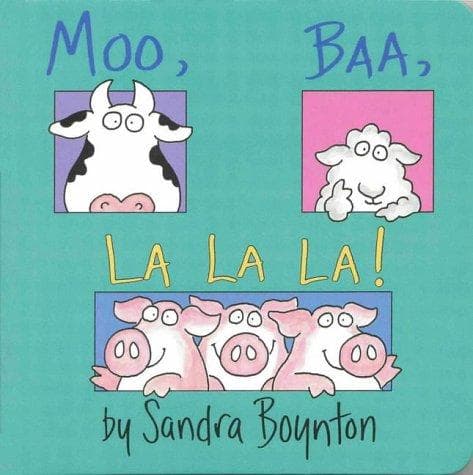
Moo, Baa, La La La (Boynton)
A sturdy, rhythmic board book of farm-animal sounds that gives very young children something to chant along with, and adults a quick, cheerful read-aloud.
What It's About
Moo, Baa, La La La is a board book from Sandra Boynton, the author of a long run of small, sturdy books for babies and toddlers. It is built around farm animals and the sounds they make, and it gives a very young reader a simple sequence of animal voices to repeat and point at. The text is short and rhythmic, meant to be read aloud rather than followed for plot.
The approach is mostly sound and cadence. Boynton leans on repetition, onomatopoeia and a playful sense of musical rhythm, so the book works more as a singalong than as a story with stakes. Her drawings are broad, bold and cheerful, with plenty of room for a child to name what they see. Adults will notice the timing: a line lands, a pause falls where a child expects a noise, and the fun is in the performance.
The experience is brief and physical. Reading it takes a few minutes, and it rewards repeat readings, chanting along and making the animal noises together. It is not a book to dig into for meaning or character. It is a book to share on a lap at bedtime or during a car ride, and it sits comfortably in a family's first library.
Read this if you…
- want a read-aloud board book for a baby or toddler
- enjoy the rhythm of simple, playful language and animal sounds
- are looking for an easy, funny book to share with a young child at bedtime
Skip it if you…
- want a story with a plot, characters, or emotional development
- are looking for a book that will hold the interest of older children or adults for long
Key Ideas
- 1
Sound as the main event
Here the sounds animals make carry most of the book. Instead of a plot, the reader gets a steady run of noises that a toddler can imitate, which turns passive looking into active participation. The book treats animal voices as the first language a child learns to play with, and it trusts that a child will find the sequence funny and satisfying on its own terms.
- 2
Rhythm and repetition for early readers
Boynton's lines are short and built on repeated patterns, which makes them easy to memorize and predict. That predictability is the point for a pre-reader: a child can join in before they can read a word. Adults reading aloud will notice how much the meter does the work, so the book rewards a slow, musical reading style more than silent skimming.
- 3
Humor built into the animals
The comedy comes from familiar farm animals doing exactly what a child expects, delivered with a wink. Boynton's characters have a deadpan, slightly exaggerated personality that adults tend to enjoy as much as children do. The jokes are small and gentle, which suits the age group, and they reward a parent who reads with some expression.
- 4
Art that invites a child to point
The illustrations are simple, high-contrast and uncluttered, so a toddler can find the animal on the page without effort. Each spread gives a child a clear target to name or touch. This is less about artistic detail and more about making the page easy to share, which is why the book works as a first encounter with pictures and language together.
Limitations
The book has very little narrative, so readers looking for plot, character arc or a satisfying ending will find it thin. Its language is deliberately limited, which suits pre-readers but gives older children and adults little to chew on. The repetition that makes it effective for a toddler can wear thin for a grown-up reading it many times in a row. Board books also have a physical life of their own: they are built to be chewed and handled, not kept pristine, so a copy may not last as long as a hardcover picture book would.
Questions Readers Ask
- Is Moo, Baa, La La La good for a baby?
- It is aimed at babies and toddlers, and its sturdy board pages, bold pictures and repeated animal sounds suit the age well. Parents often use it as an early read-aloud because the rhythm is easy to follow and a child can start imitating the sounds quickly. It is a gentle first book, though it offers little story for an older child to follow.
- Is it a story or a picture book?
- It is a picture book in board-book form, so it is listed as fiction but works more like a rhythmic sound book than a narrative. There is no complex plot to follow. The enjoyment comes from reading it aloud, pointing at the animals and making the noises together.
- How does it compare to other Boynton books?
- Boynton wrote many short, playful board books with a similar tone, so readers who like this one often enjoy her other titles for the same age group. Her books share a sense of humor and a focus on sound and rhythm. If you want more story, look for a longer picture book; if you want more of the same playful feel, try her other board books.
- Published
- 1982
- ISBN
- 9780689863028
- Difficulty
- beginner
- Category
- Fiction
Book details and cover from Google Books.
Ready to read Moo, Baa, La La La (Boynton)?
Get your copy on Amazon, or listen to it on Audible. We earn a commission if you buy through these links.