
We earn a commission if you buy through these links. Learn more
Monster
Guide by the Books of the Day editors · Updated · How we write our guides
A Harlem teenager on trial for a robbery that turned deadly tells his own story as a screenplay, and the form makes the book's question about identity unusually sharp.
What Creators Say About Monster
2 creators reviewed Monster on YouTube between 2014 and 2020, with 109.7K views between them. Their opinions are their own; we picked these reviews, we didn't write them.
What It's About
Monster follows Steve Harmon, a 16-year-old from Harlem awaiting trial in an adult jail. He is charged with felony murder in connection with a store robbery in which a man was killed, accused of serving as the lookout. Much of the tension sits in what the jury will decide, but also in whether Steve can recognize himself in the person everyone else seems to see.
Myers tells the story as a screenplay Steve writes in his cell, with camera directions, dialogue, and short prose notes in his own voice. The form matters: Steve is trying to see his life as a film, which keeps him at a distance from the fear and shame he feels, and the reader gets to watch him slip in and out of that distance. Those shifts are where the book is most affecting.
Reading it takes little time, but it lingers. Dialogue carries most of the weight, so you piece together the courtroom and the cell from fragments rather than long description. It is a book that asks you to judge along with the characters and to notice how easily the justice system, and the public, flatten a teenager into a type.
Read this if you…
- want a short, serious novel that takes a teenager's point of view seriously
- are interested in how form and storytelling can carry a book's central question
- want to think about race, justice, and how young people are judged
Skip it if you…
- need a clear, tidy resolution with every question answered
- prefer long, descriptive prose and detailed legal drama
Key Ideas
- 1
Identity as something others assign
Steve is constantly asked to explain who he is, and the answers other people give, from prosecutors to fellow inmates, are shaped by how he looks and where he lives. The book keeps returning to the gap between the person Steve believes he is and the label that the court and the press apply to him. Readers are invited to notice how quickly appearance becomes a verdict before any facts are weighed.
- 2
Filmmaking as a way to keep distance
Writing his experience as a movie gives Steve a tool for control. He can frame scenes, choose what the camera sees, and imagine himself from outside. That detachment is both a coping mechanism and a kind of evasion, and Myers lets the reader feel both the relief and the cost of it. The form is central to the book's meaning rather than a gimmick.
- 3
Fear and the performance of toughness
Steve is pressured to act hard in jail and in the courtroom, and he often feels that his real reactions are being hidden behind a mask. The book examines how young men learn to perform indifference to survive, and how that performance can be mistaken for guilt or coldness by people who do not know them. It is a quiet but sharp study of masculinity under pressure.
- 4
A justice system that reduces people to labels
Monster shows how a criminal case can turn a teenager into a type before anyone has heard his story. The trial is seen through a young person's eyes, so the procedures can feel confusing and arbitrary. The book does not offer easy answers about guilt, but it makes a strong case that the process itself shapes outcomes in ways that deserve scrutiny.
Limitations
The legal process is simplified, and readers looking for courtroom procedure or detailed strategy will find it thin. The screenplay format is sparse, so some characters stay sketched rather than fully developed. The ending is deliberately open, which frustrates some readers who want closure. Because the book is written for young adults, its treatment of the prison system and its violence is restrained, and some adult readers may find it more of an opening than a full examination.
Questions Readers Ask
- Is Monster appropriate for younger readers?
- It is widely taught and read in middle and high school, and most teens who handle serious fiction will manage it. It deals with a murder charge, time in an adult jail, and fear and violence, so parents and younger readers should expect mature themes. The language and content are restrained compared with many adult novels, which is part of why it works in classrooms.
- How does Monster compare to The Hate U Give?
- Both feature teenagers caught in a justice system and ask how society sees young people of color. Monster is shorter and more formally experimental, told as a screenplay, while The Hate U Give is a longer, more conventional novel with a stronger focus on activism and community. Readers who like one often find the other rewarding.
- Published
- 1999
- ISBN
- 9780061782893
- Difficulty
- beginner
- Category
- Children's Books
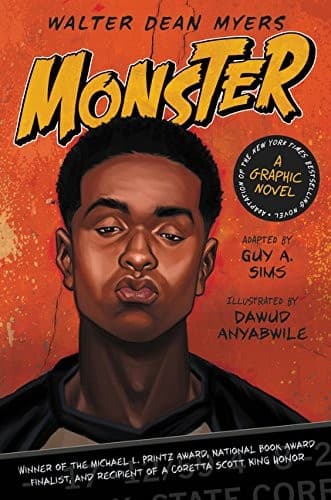
Book details and cover from Google Books.
Ready to read Monster?
Get your copy on Amazon, or listen to it on Audible. We earn a commission if you buy through these links.