
We earn a commission if you buy through these links. Learn more
Mockingbird
Guide by the Books of the Day editors · Updated · How we write our guides
A National Book Award winner that makes grief and empathy legible through a narrator who reads other people's feelings the hard way, and who stays with you long after the last page.
What Creators Say About Mockingbird
2 creators reviewed Mockingbird on YouTube between 2013 and 2019, with 4.8K views between them. Their opinions are their own; we picked these reviews, we didn't write them.
What It's About
Mockingbird is a middle-grade novel narrated by Caitlin, a ten-year-old who sees the world in literal, carefully ordered terms. Her older brother Devon was killed in a school shooting, and the book follows her through the months afterward as her father, her teachers, and a school counselor try to help her grieve. Caitlin is on the autism spectrum, and her difficulty reading faces and tone shapes nearly every scene. Erskine writes from inside that perspective, so the reader learns what Caitlin notices, what she misses, and what she is trying to work out.
The prose is short, plain, and often quietly funny. Chapters are brief, the sentences are direct, and the emotional weight comes from what Caitlin cannot say rather than from lyrical description. Her attempts to understand other people, sometimes through rules she invents for herself, make the book feel like watching someone translate a language in real time. The title points to Harper Lee's novel and its interest in seeing people clearly, and that thread runs through the story without turning into a lecture.
Reading it is quick, often sad, and oddly comforting. Most adults can finish it in an evening or two. The subject is heavy, but the emotional payoff is earned, and the book trusts young readers to sit with discomfort.
Read this if you…
- want a short, emotionally direct novel about grief and empathy
- enjoy first-person narrators who see the world differently from everyone around them
- are looking for a gentle entry point to fiction about disability and loss, for yourself or a young reader
Skip it if you…
- need a fast-moving plot with action, twists, or a strong mystery
- want a school shooting explored in depth, with its causes and aftermath examined in detail
Key Ideas
- 1
Grief filtered through a literal mind
Caitlin does not process loss the way most narrators do. She fixates on facts, routines, and concrete details, and the gap between what she feels and what she can name becomes the source of the book's emotional power. Readers see grief in its raw, unpolished form, which often feels more honest than a conventionally emotional account would.
- 2
Empathy treated as a learned skill
Caitlin is not cold, but understanding other people does not come naturally to her. The book presents empathy as something that can be practiced, studied, and built over time, with mistakes along the way. This framing is gentle and useful, especially for young readers who feel that social signals are obvious to everyone except them.
- 3
How a community responds to tragedy
The story shows the adults around Caitlin reacting to a shared loss in uneven, sometimes clumsy ways. Some help, some avoid the subject, and some simply do not know what to say. The book takes these responses seriously without turning the adults into villains, which gives it a wider view than a story told only from a child's perspective.
- 4
First-person voice as the main craft choice
Almost everything in the book depends on Caitlin's voice. Her blunt observations and odd logic produce humor and ache in the same sentence. Erskine uses the limits of her narration deliberately, so the reader often understands more than Caitlin does, and that gap is where much of the book's meaning lives.
Limitations
The book is told through one narrator, so autism is shown through a single lens, and some readers feel Caitlin's arc leans toward learning to match neurotypical emotional norms. Its middle-grade scope keeps the prose simple and the themes close to the surface, which experienced adult readers may find thin. The resolution is hopeful and somewhat tidy. The shooting happens offstage and is handled with restraint, but the subject is sensitive, and parents may want to read it first.
Questions Readers Ask
- Is Mockingbird a children's book or an adult novel?
- It is a middle-grade novel, usually aimed at readers around ages 8 to 12. The sentences and vocabulary are accessible, but adults often find it moving because of the emotional honesty and the way Caitlin's perspective reveals what the adults around her are missing. It works well as a read-aloud or a shared book for a parent and child.
- How does Mockingbird compare to The Curious Incident of the Dog in the Night-Time?
- Both feature literal-minded narrators on the autism spectrum who read the world in unusual ways. Curious Incident is a mystery for older readers with a wider scope. Mockingbird is shorter, more emotional, and centered on grief after a specific tragedy. If you liked the voice in one, the other is a natural next read.
- Does Mockingbird still hold up?
- Yes, for most readers. The emotional core, a child trying to understand grief and other people, does not date. Some attitudes about autism in the book reflect the period it was written, and readers today may want more depth on the subject. Its handling of community and loss remains effective.
- Published
- 2010
- ISBN
- 9781619592810
- Difficulty
- beginner
- Category
- Fiction
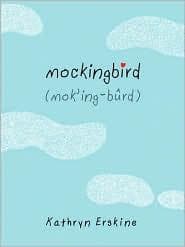
Book details and cover from Google Books.
Ready to read Mockingbird?
Get your copy on Amazon, or listen to it on Audible. We earn a commission if you buy through these links.