
We earn a commission if you buy through these links. Learn more
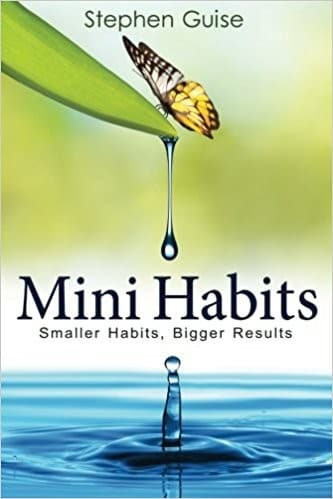
Mini Habits
Guide by the Books of the Day editors · Updated · How we write our guides
A short, practical argument that tiny, almost embarrassingly easy daily actions can build momentum where big resolutions keep collapsing.
What Creators Say About Mini Habits
2 creators reviewed Mini Habits on YouTube between 2015 and 2020, with 143.7K views between them. Their opinions are their own; we picked these reviews, we didn't write them.
What It's About
Mini Habits is built on a single, deliberately modest premise: when you are trying to change behavior, make the daily commitment so small that you cannot reasonably fail it. Guise asks readers to pick one action, such as a single push-up, one page of reading, or a few minutes of tidying, and to do it every day. The mini habit is a floor rather than a ceiling. Once you have shown up, you are free to do more, and the book argues that most people will, because starting is the hardest part.
The writing is blunt, brisk, and repetitive in the way self-help often is, and it tends to return to the same few points while offering a lot of encouragement aimed at readers who feel they have failed before. Expect short sections, direct instructions, and motivational language rather than research deep dives or long case studies. The book is quick to read, and much of its value comes from the permission it grants: you do not need a better plan or more discipline, only a smaller target and a way to track it.
The experience is closer to a coaching session than a manual. It will feel most useful if you have a specific habit you keep abandoning, and least useful if you are looking for a rigorous account of how habits form in the brain. Read it as a practical playbook for getting started, and treat its claims about rapid transformation with some skepticism.
Read this if you…
- keep starting and quitting big resolutions and want a different approach
- want a fast, low-friction method you can apply tomorrow morning
- find long, detailed behavior-science books hard to finish and prefer short practical guidance
Skip it if you…
- want a rigorous, research-heavy account of how habits form and change
- expect one simple habit trick to resolve deeper problems such as addiction or depression
Key Ideas
- 1
Make the habit too small to fail
The core move is shrinking a goal until skipping it feels absurd. Guise argues that failure usually comes from ambitious plans that demand willpower on bad days, not from a lack of character. A tiny commitment sidesteps that by asking for almost nothing, so even a difficult day leaves the streak intact.
- 2
Treat the minimum as a floor, not a ceiling
The minimum is a commitment to show up, and anything beyond it is a bonus. Readers often find that once they start, they naturally do more, which the book frames as momentum rather than discipline. The distinction matters because it removes the pressure to hit a big number every day.
- 3
Willpower is a poor foundation for change
The book treats motivation as unreliable and leans on structure instead: a fixed daily trigger, a specific action, and a simple record of having done it. Its position is that you will not always feel like acting, so the system has to work on flat, tired days as well as good ones.
- 4
Avoid the all-or-nothing collapse
Guise pays attention to the emotional pattern of breaking a streak and quitting entirely. He suggests that a missed day is not the real problem; the real risk is the story you tell yourself afterward. Keeping the bar low makes recovery easier and restarting far less dramatic.
Limitations
The book's central claim leans heavily on anecdote and encouragement rather than controlled evidence, so readers looking for scientific backing will find it thin. Its advice fits best for building simple, repeatable actions; it says less about complex goals, skill-building that needs sustained effort, or problems with clinical roots. Some readers find the upbeat, repetitive style grating, and the framing of minimal effort for maximal results can overpromise. Use it as a starting method rather than a complete theory of change.
Questions Readers Ask
- Is Mini Habits still useful if I already know about habit formation?
- Probably less than it would be for a first-time reader. Many of its ideas overlap with later, more research-based habit books that cover cues, rewards, and environment in more depth. Its strength is practicality: if you already know the theory but never act on it, the insistence on starting absurdly small may still be the nudge you need.
- How does it compare to Atomic Habits?
- Atomic Habits by James Clear covers similar ground with more research, more structure, and a deeper treatment of identity and environment. Mini Habits is shorter, simpler, and more motivational in tone. If you want one book that explains why habits work, choose Clear's. If you want a single rule to start tomorrow, Guise's is quicker to act on.
- Published
- 2013
- ISBN
- 9781956980004
- Difficulty
- beginner
- Category
- Psychology
Book details and cover from Google Books.
Ready to read Mini Habits?
Get your copy on Amazon, or listen to it on Audible. We earn a commission if you buy through these links.