
We earn a commission if you buy through these links. Learn more
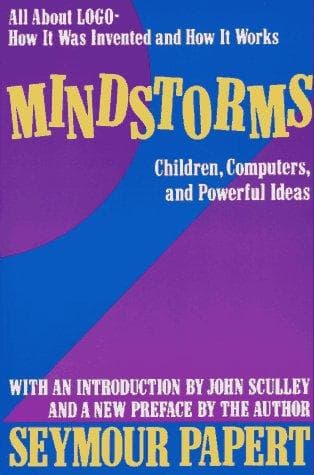
Mindstorms
Papert's 1980 classic argues that children learn best by building and reflecting, and it still offers a sharp case for rethinking how schools teach math and computing.
What It's About
Mindstorms, published in 1980, is Seymour Papert's argument that computers could change how children learn, not just what they study. Papert worked alongside Piaget in Geneva and helped create the Logo programming language, and he writes from the conviction that children grow by constructing things they can examine and improve. The book is part manifesto, part reflection on his own learning, and part introduction to the turtle that anchors Logo.
The style is conversational and digressive. Papert moves between stories about children and gears, critiques of classroom habits, and sustained explanations of how Logo works. A reader without programming experience can follow most of it, though the more technical passages on geometry and mental models take patience. He tends to return to a small set of core ideas from several angles rather than building a tight, step-by-step case.
Reading it feels like sitting in on a long argument with a thoughtful teacher who is convinced that school has its priorities wrong. The book is hopeful and sometimes combative, and that optimism is much of its appeal. Expect less how-to than the title might suggest and more a different way of seeing learning, mathematics, and the role of the machine in a child's mind.
Read this if you…
- are a teacher, parent, or designer interested in how children learn through making things
- want a historically important text on educational technology and the origins of Logo
- enjoy big, opinionated ideas and do not mind a loose, digressive structure
Skip it if you…
- want a practical guide to teaching programming with current tools or curricula
- need a tight, step-by-step argument or a book that stays strictly on technical detail
Key Ideas
- 1
Learning by building things you can reflect on
Papert's central claim is that people learn most deeply when they construct something external and then think about what it does. A child who programs a shape, watches it go wrong, and repairs it is doing real intellectual work. He contrasts this with passively receiving instruction, and he treats the object being built as a bridge between concrete experience and abstract understanding.
- 2
Turtle geometry as an entry point to mathematics
The Logo turtle moves on screen according to commands a learner writes, which makes geometry something you do rather than memorize. Papert uses this to argue that formal math can be approached through action and trial. The examples show how a simple idea about direction and repetition can open onto larger questions without requiring the learner to start from abstraction.
- 3
Thinking through your own body
Papert describes how children often understand the turtle by imagining themselves as it, walking and turning to work out a path. He calls this kind of learning body-syntonic, meaning it draws on familiar physical intuition. The idea is that bodily knowledge can become a resource for reasoning about systems that would otherwise feel alien or forbidding.
- 4
Computers as objects to think with
Papert pushes back against the common use of computers to deliver lessons or drill facts. He argues they should be tools for exploring ideas the learner controls, something closer to a set of materials than a tutor. This reframing is the heart of the book, and it shapes his critique of how schools adopt technology without changing what children are asked to do.
- 5
A critique of how schools teach
Much of the book is an argument about school itself, including its habits of instruction, testing, and fear of mistakes. Papert suggests that many children struggle with math not because they lack ability but because the way it is taught makes them feel incapable. His critique reaches beyond computers and asks what learning environments should look like.
Limitations
The book is dated in its hardware and examples, since it was written for the computers of 1980 and does not address the web, modern languages, or today's devices. Some of its predictions about schools being transformed have not come true, and critics note that the evidence for broad gains in general math skills from Logo was thinner than Papert hoped. Readers may also find the writing repetitive or the tone overly confident. The book is best read as an argument and a historical document rather than a settled account of what works.
Questions Readers Ask
- Do I need programming experience to read Mindstorms?
- No. Papert explains the ideas in plain language, and the Logo examples are introduced gently. Some chapters on geometry and his theoretical framing demand more focus, but a curious adult with no coding background can follow the core argument. The book is more about ways of thinking than about syntax, so you will get more from it by reading slowly and considering the examples than by trying to memorize commands.
- Is Mindstorms still relevant today?
- Yes, mainly for its ideas rather than its technology. The emphasis on learning through making, and the critique of instruction-heavy classrooms, still feels current in debates about coding, STEM education, and educational tech. The specific tools and computers are outdated, so treat the book as a foundation for thinking about learning rather than a manual for building lessons today.
What Creators Say About Mindstorms
Reviews from readers on YouTube. Their opinions are their own.
- Published
- 1980
- ISBN
- 9780745016047
- Difficulty
- intermediate
- Category
- Tech
Book details and cover from Google Books.
Ready to read Mindstorms?
Get your copy on Amazon, or listen to it on Audible. We earn a commission if you buy through these links.