
We earn a commission if you buy through these links. Learn more
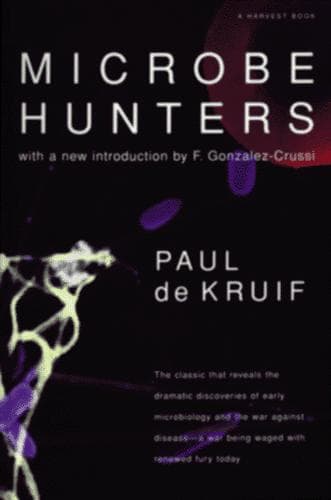
Microbe hunters
Guide by the Books of the Day editors · Updated · How we write our guides
A 1926 set of vivid portraits of the scientists who proved germs cause disease, still one of the most readable introductions to early microbiology and its heroic, reckless pioneers.
What Creators Say About Microbe hunters
2 creators reviewed Microbe hunters on YouTube between 2023 and 2024, with 319 views between them. Their opinions are their own; we picked these reviews, we didn't write them.
What It's About
Microbe Hunters is a 1926 collection of biographical portraits of the scientists who discovered that microorganisms cause disease and then went after them. De Kruif, himself a trained bacteriologist, tells the stories as adventures: Antonie van Leeuwenhoek grinding his own lenses to look at tiny creatures in pond water, Pasteur chasing spoilage and silkworm diseases, Koch isolating the bacteria behind anthrax and tuberculosis, and later hunters who took on yellow fever, malaria, and other killers.
The approach is narrative rather than textbook. De Kruif writes in a brisk, emotional, sometimes melodramatic voice, reconstructing scenes and dialogue that the historical record could not have supplied. He makes rivalries, failed experiments, and self-experiments the engine of each chapter, and he admires his subjects openly, with little reserve.
The experience is fast and entertaining more than rigorous. Each portrait stands on its own, so you can read them in any order or in pieces between other books. It works well as a first look at how science actually progresses through trial, error, and stubbornness, and at the nerve of researchers who sometimes tested risky treatments on themselves.
Read this if you…
- want an accessible, story-driven introduction to the history of germ theory
- enjoy biographies of scientists that read more like adventure stories
- are curious how early researchers worked before modern lab standards existed
Skip it if you…
- want an accurate, footnoted history you can cite in academic work
- are looking for up-to-date science on viruses, immunology, or antibiotics
Key Ideas
- 1
Seeing the invisible changed medicine
The book's central thread is that diseases were long blamed on bad air, humors, or bad luck until people with better lenses and careful technique showed that specific microbes were responsible. Each portrait shows how hard that shift was to win, given how many doctors resisted the idea that something unseen was killing their patients.
- 2
Method as the real hero
De Kruif spends more energy on how the hunters worked than on their genius: pure cultures, staining, controls, and repeated animal tests. Readers come away with a clearer sense that breakthroughs were usually the product of disciplined, tedious procedure rather than a single flash of insight.
- 3
Rivalry, ambition, and bad feelings
Competition between laboratories and countries drives much of the drama. De Kruif does not hide that his heroes could be vain, territorial, or unfair to one another, and he treats those human flaws as part of the story of how the field moved forward.
- 4
Courage that sometimes crossed into recklessness
Several portraits center on researchers who risked infection or death through self-experiments and field work with deadly pathogens. The book celebrates this boldness, though a modern reader may find some of it alarming and hard to justify.
- 5
From identifying causes to chemical cures
The later chapters move from finding the organism to searching for drugs and immunizations that could stop it. This shift from diagnosis to treatment is where the book feels most like a preview of modern pharmacology, even though the specific science it describes has since been superseded.
Limitations
The book is nearly a century old, and much of its science has been superseded: it predates antibiotics, modern virology, and most of modern immunology. De Kruif's dramatized dialogue and scenes are often invented, and his heroic framing exaggerates some achievements while simplifying the contributions of colleagues. The cast is almost entirely European and American men, so women and non-Western researchers are largely absent. Read it as a vivid entry point, then check details against a more recent history.
Questions Readers Ask
- Is Microbe Hunters still accurate?
- Not entirely. The broad story of how germ theory was established still holds, but de Kruif invented dialogue and simplified some events, and the science reflects 1926 knowledge. Treat it as an engaging overview and verify specific claims against modern histories before relying on them.
- Is it a good companion to Arrowsmith?
- Yes, with a caveat. De Kruif, a former bacteriologist, later worked with Sinclair Lewis on the novel Arrowsmith, and the two books share a vision of research as a noble, often frustrating pursuit. Microbe Hunters offers real history where the novel offers fiction, so reading them together gives a useful contrast.
- Who is it best for if I know nothing about microbiology?
- It suits general readers well, since it needs no scientific background and explains ideas through the people who discovered them. Pair it with a current popular science book on infectious disease if you want to see how the field has changed since the 1920s.
- Published
- 1926
- ISBN
- 9780156002622
- Difficulty
- beginner
- Category
- History
Book details and cover from Google Books.
Ready to read Microbe hunters?
Get your copy on Amazon, or listen to it on Audible. We earn a commission if you buy through these links.