
We earn a commission if you buy through these links. Learn more
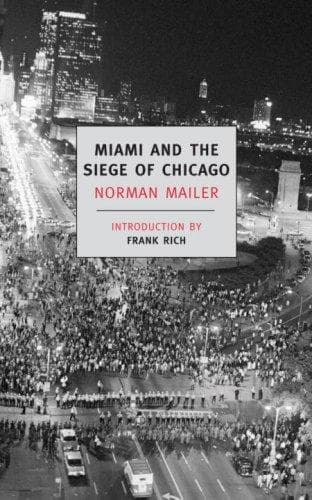
Miami and the siege of Chicago
Norman Mailer's first-person chronicle of the 1968 Republican and Democratic conventions is a sharp, funny portrait of a divided country and of a writer who cannot stay neutral.
What It's About
Norman Mailer covered the Republican convention in Miami Beach and the Democratic convention in Chicago in the summer of 1968, and this book is his account of both. It is less a straight news report than a chronicle in which Mailer writes about himself in the third person, as a character who is excited by politics, suspicious of nearly everyone, and never quite sure what he is seeing. The book is split into two halves, one for each city, and the second is the more vivid, covering the street confrontations around the Democratic gathering.
The prose is long-breathed, digressive, and often very funny, moving from a crowd scene to a stray memory or a sudden theory about American character without much warning. Mailer stops often to speculate about the nation's mood, about the media and technology, and about what sort of person might lead the country. Readers who want a clean sequence of events will find this frustrating, because the narrative keeps pausing for opinions and jokes. Readers who enjoy a writer thinking out loud will find it electric.
Reading it now is an unusual experience. The candidates and factions are long gone, but the sense of a country splitting over war, race, and generational rage feels uncomfortably familiar. The book works less as a record of who won than as a portrait of a mood, and of a writer trying to decide whether he belonged to the movement he was watching.
Read this if you…
- are interested in 1960s American politics and how the conventions looked from the street
- enjoy essayistic reportage with a strong, opinionated narrator
- want a sense of how the mood of 1968 felt, not just what happened
Skip it if you…
- need a neutral, fact-by-fact account of convention votes and party deals
- find self-regarding narrators hard to tolerate for a whole book
Key Ideas
- 1
Politics as theater and ritual
Mailer treats the conventions as staged spectacles where the real decisions were often made elsewhere. He reads the banners, music, speeches, and crowd management as signals about who holds power and how the system presents itself to the public. This lens makes the events feel like ceremonies rather than neutral procedures.
- 2
The writer as participant and character
By placing himself inside the story under his own name, Mailer admits his vanity, fears, and biases. The reporting is partly about the reporter, so the reader is always aware of the observer as well as the observed. This self-scrutiny is one of the book's most original features.
- 3
The Chicago streets as a clash of generations
The confrontations in Chicago are presented as a struggle between a rigid established order and a young movement that did not yet know how to win. Mailer describes the violence and the confusion with a mix of horror and fascination, and he questions what the protesters hoped to achieve.
- 4
A nation divided over war and identity
Vietnam, race, and the generation gap run beneath every scene. Mailer argues that the country's crisis is also a crisis of self-image, in which Americans no longer agree on what their society is for. The argument feels personal and sometimes overreaching, but it gives the book its urgency.
- 5
Prose that thinks out loud
The distinctive quality of the book is its voice. Long sentences, wry asides, and bursts of speculation make the reading feel like listening to a restless, opinionated companion. The style is the main reason the book still rewards attention beyond its historical content.
Limitations
Mailer's persona can be exhausting, and his self-mythologizing is part of the book's design but also a source of irritation. Some of his comments on women and on the motives of the protesters are dated or unfair. The book is thin on the mechanics of delegate politics and party machinery, and many references to figures of 1968 assume knowledge that today's readers may lack. Its judgments are partial and sometimes contradictory, which is part of its appeal but means it is not a balanced history.
Questions Readers Ask
- Is this a good introduction to the 1968 conventions?
- It works better as a companion than a primer. Mailer assumes you already know the broad outline of the year, so a short timeline beforehand helps. Once you have that, the book gives you the texture of the conventions and the protests that drier histories often miss.
- How does it compare with more conventional histories of 1968?
- Conventional histories give you the sequence of events and the policy stakes more clearly. Mailer gives you the feel of being in the crowd and an argument about what those events meant. Read a standard account for the facts and this one for interpretation and atmosphere.
- Published
- 1968
- ISBN
- 9781590172964
- Difficulty
- intermediate
- Category
- History
Book details and cover from Google Books.
Ready to read Miami and the siege of Chicago?
Get your copy on Amazon, or listen to it on Audible. We earn a commission if you buy through these links.