
We earn a commission if you buy through these links. Learn more
Men Explain Things To Me
A short, pointed essay collection that takes the everyday experience of being talked over and dismissed and shows how it connects to silencing and violence against women.
What It's About
Men Explain Things to Me is a short essay collection by Rebecca Solnit, a writer known for cultural criticism and books about place, history and politics. The title essay began with a moment at a dinner party, when a man lectured her at length about a subject she had written about herself, without any sign that he knew who she was. That small, familiar humiliation becomes a window onto something larger: the habit of assuming women don't know what they're talking about, and the way that assumption shapes who gets heard.
The rest of the book widens the lens. Solnit moves between personal anecdote, reporting and argument, looking at how doubt about women's credibility can slide into silencing and, at its extreme, into violence. Her style is conversational but precise, with long sentences that pile up examples before turning sharply. She writes both as someone who has been on the receiving end and as an observer of public life, and she is willing to name patterns rather than hedge them.
Reading it feels less like studying a theory than like sitting with a sharp, angry, funny companion who keeps asking you to notice what you were trained not to see. The pieces are short enough to finish in a sitting, and they reward slow reading because the arguments are built on small, carefully chosen observations.
Read this if you…
- want a short, pointed book on how gender shapes who gets believed in everyday conversation
- already like Solnit's essays and want her direct, personal voice on feminism
- want a starting point on gender and power that you can finish in a few evenings
Skip it if you…
- want a rigorous academic study with sources and data throughout
- are looking for technology or internet culture, since despite the Tech label this book is about gender and public life rather than tech
Key Ideas
- 1
Being talked over as a form of dismissal
Solnit treats condescension and interruption as more than rudeness. When a man assumes he knows more than the woman in front of him, the message is that her knowledge doesn't count. The book's central insight is that these small moments are how a wider social hierarchy gets maintained, one conversation at a time.
- 2
Credibility is handed out unevenly
Who is believed, and who has to prove themselves repeatedly, follows lines of gender and power. Solnit shows how women's testimony is often met with doubt by default, and how that default makes it harder for women to speak about what happens to them. She asks readers to notice the asymmetry rather than treat it as individual bad luck.
- 3
From everyday condescension to silencing
The essays connect ordinary slights with more serious harms, including violence. The argument is not that a dinner-party lecture equals assault, but that a culture that routinely discounts women makes it easier for them to be silenced when the stakes are higher. This chain of reasoning is the book's most important and most debated move.
- 4
Naming patterns as a way to resist them
Solnit believes that giving a pattern a name and describing it clearly is a form of power. Much of the book is an effort to make visible what people have learned to shrug off. It is a book about language and attention as much as about gender, and it argues that noticing is the first step toward changing what happens.
Limitations
Some essays feel dated, written across a decade of fast-moving online and political debate, and some arguments land more as sharp impressions than as systematic evidence. Critics have pointed to the book's vantage point, which is largely white, middle-class and American, and to the way the title's term has been used loosely in later arguments. Because it is a collection rather than one sustained argument, it can feel uneven, and it offers reflection rather than policy solutions.
Questions Readers Ask
- Is this book really just about mansplaining?
- The title essay is the best-known piece and gave the book its name, but the collection goes further. It looks at how women's testimony gets discounted, how that can lead to silencing and violence, and how everyday habits keep women quiet. Readers expecting only light satire will find something more serious and more angry.
- Is Men Explain Things to Me still relevant?
- Many of its observations about credibility and dismissal still apply, and the book remains widely read and discussed. Some references belong to their moment, so it is best read as a snapshot of arguments that are still ongoing rather than a complete account of the present.
- How does it compare to Solnit's Hope in the Dark?
- Hope in the Dark is more about activism and why hope can be a practical stance. Men Explain Things to Me is angrier and more focused on how women are disbelieved and silenced. Both are short and essayistic, so the choice depends on whether you want motivation or diagnosis.
- Published
- 2014
- ISBN
- 9781608464661
- Difficulty
- beginner
- Category
- Tech
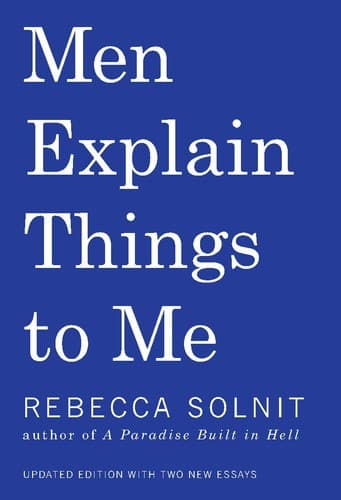
Book details and cover from Google Books.
Ready to read Men Explain Things To Me?
Get your copy on Amazon, or listen to it on Audible. We earn a commission if you buy through these links.