
We earn a commission if you buy through these links. Learn more
Men are From Mars, Women are From Venus
A 1992 bestseller that uses a Mars-and-Venus metaphor to explain common friction between partners, offering simple language couples still use, though its gender claims are contested.
What It's About
Men Are from Mars, Women Are from Venus is a relationship self-help book, not a novel, so the Fiction label on this listing doesn't fit. John Gray, a relationship counselor and author, argues that men and women often bring different emotional needs and stress responses into their relationships, and that many conflicts come from each partner reading the other through their own rules. He presents these differences as general tendencies rather than fixed traits, illustrating them with everyday examples and scenarios.
The style is breezy and reassuring, with short sections, lists, and quick practical tips. Reading it feels like sitting across from an upbeat counselor who wants you to stop taking your partner's behavior personally. The advice centers on specific behaviors: how to ask for help without sounding critical, how to listen without immediately fixing, and how to offer small gestures that matter to the other person.
The experience is more about reframing than rigorous argument. It reads quickly, and its most useful takeaway is often a shared vocabulary for a recurring argument. Treat it as a starting point for conversation rather than a scientific account of how men and women differ.
Read this if you…
- want a simple, memorable framework for recurring couple arguments
- are newly partnered or in a rough patch and want an accessible starting point
- prefer warm, practical advice over academic research
Skip it if you…
- want evidence-based research or clinical rigor
- find broad claims about men and women frustrating or reductive
Key Ideas
- 1
Differences as a source of friction
Gray's central claim is that many couple conflicts arise not from bad intentions but from mismatched expectations. Each partner assumes the other values what they value, so a well-meant gesture can land as neglect. The book's most lasting contribution is encouraging readers to look for this mismatch before assuming the worst about their partner.
- 2
Stress, withdrawal, and the need to talk
The book suggests that under pressure, one partner may want quiet time to sort things out alone, while the other wants to talk through the problem out loud to feel close again. Gray frames these as different ways of coping, not signs of indifference. Recognizing the pattern can stop a pursue-and-retreat cycle from escalating.
- 3
Giving and receiving love in different ways
Gray argues that people tend to show affection in the forms they themselves find meaningful, which may not be the forms their partner notices. Someone who feels loved through practical help may overlook a partner who wants more verbal reassurance. The idea is simple, but it prompts useful questions about what each person actually needs.
- 4
Replacing criticism with clearer requests
A recurring theme is that criticism tends to make the other person defensive, while a specific, positive request is more likely to get a response. The book offers phrasing ideas for turning complaints into invitations. Readers who already communicate well may find this familiar, but it is a practical reminder for couples stuck in blame.
Limitations
The book's main weakness is its generalizations. Critics argue that Gray presents gendered tendencies as near-universal, with little rigorous evidence behind them, and that the framework can reinforce traditional roles and rigid binary thinking. It does not seriously address abuse, same-sex relationships, or differences in individual personality and culture. Some examples and phrasing also feel dated, so the advice works best as a loose guide rather than a literal rulebook.
Questions Readers Ask
- Is Men Are from Mars, Women Are from Venus still worth reading?
- Yes, if you treat it as a communication guide rather than a scientific map of gender. Its core suggestion, that partners should check their assumptions before reacting, remains useful. The examples are dated and the gender generalizations are contested, so read it alongside more current, research-based relationship work.
- How does it compare to The Seven Principles for Making Marriage Work?
- John Gottman's book is grounded in decades of research with couples and is more structured and prescriptive. Gray's book is lighter, more metaphor-driven, and centered on gender differences. Gottman suits readers who want evidence and concrete methods, while Gray suits those who want an easy, encouraging entry point.
- Published
- 1992
- ISBN
- 9780694517206
- Difficulty
- beginner
- Category
- Fiction
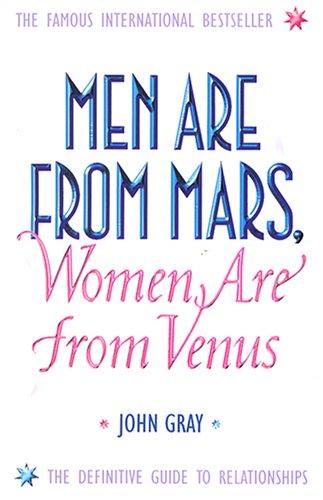
Book details and cover from Google Books.
Ready to read Men are From Mars, Women are From Venus?
Get your copy on Amazon, or listen to it on Audible. We earn a commission if you buy through these links.