
We earn a commission if you buy through these links. Learn more
Measure what matters
by John Doerr
The clearest introduction to OKRs, the goal-setting method that helped Google and many other organizations focus, with practical templates you can use with a team this week.
What It's About
Measure What Matters is John Doerr's account of Objectives and Key Results, a goal-setting system he learned at Intel and later brought to Google in the late 1990s. Doerr, a venture capitalist, presents the method as a working toolkit rather than an academic theory. The core idea is simple: pair a clear, inspiring objective with a few measurable key results that show whether you are getting there.
The reading experience is brisk and anecdotal. Doerr moves between short case histories, examples of strong and weak objectives, and guidance on running check-ins, so the mechanics are easy to pick up. The tone is upbeat and enthusiastic, closer to a manager's pep talk than a research-driven study. Much of the evidence comes from success stories at companies and nonprofits he has worked with, which gives the book energy but limited critical distance.
It is most useful if you are setting goals for a team, a startup, or a project and want a simple framework you can apply quickly. Expect a book that is light on theory and heavy on advocacy, with the same principles repeated in many chapters. Readers looking for a deep analysis of why goal systems succeed or fail, or for careful comparisons with other management methods, will need to look elsewhere.
Read this if you…
- are setting goals for a team, startup, or nonprofit and want a concrete framework
- want to understand how Google and similar companies structured their planning
- prefer short, practical examples and templates over long theoretical argument
Skip it if you…
- are looking for a critical, research-based analysis of goal-setting science
- already run a mature OKR process and want new ideas beyond the basics
Key Ideas
- 1
Objectives paired with measurable key results
An objective states what you want to achieve in plain, motivating language. Key results are a small number of numbers that show whether you are succeeding. Doerr's central point is that the two work together: the objective gives direction and meaning, while the key results keep the effort honest and make progress visible to everyone.
- 2
Focus over a long list of priorities
Doerr argues that most teams fail because they try to do too much. The method encourages a short list of priorities, each with a clear owner and a defined outcome. The book distinguishes between commitments that must be met and aspirational goals that are meant to stretch people, and it recommends being deliberate about which is which.
- 3
Stretch goals and moonshot thinking
Doerr encourages setting targets that seem slightly out of reach, on the reasoning that ambitious goals pull out better work than safe ones. He presents this as a way to think bigger without setting people up to fail, since a stretch goal is not expected to be fully achieved every cycle.
- 4
Transparency and regular check-ins
OKRs are meant to be visible across the organization, so people can see what others are working on and where they can help. Doerr pairs this with frequent conversations, feedback, and recognition, which he presents as the habits that keep goals alive rather than turning them into a yearly paperwork exercise.
Limitations
The book leans heavily on success stories, many drawn from companies Doerr was closely involved with, so it rarely examines failed implementations in depth. Critics point out that OKRs can become a box-ticking ritual, or be tied too closely to compensation, which the book does not fully resolve. It says less than readers might like about measuring intangible or long-term work, and the repetition across chapters can feel padded. Treat it as a practical starting point rather than a complete account.
Questions Readers Ask
- Is Measure What Matters still relevant?
- Yes. OKRs are widely used by technology companies and many other organizations, so the core method remains current. Some of the examples are dated, and newer books offer more detailed implementation guidance, but the basic framework of objectives and key results has held up well.
- How does it compare to Radical Focus?
- Radical Focus by Christina Wodtke is also about OKRs and is more of a hands-on workbook, with more step-by-step guidance on rolling the system out. Measure What Matters has more of Doerr's personal story and advocacy, so it suits readers who want the why as well as the how.
- Published
- 2017
- ISBN
- 9780241290873
- Difficulty
- beginner
- Category
- Business
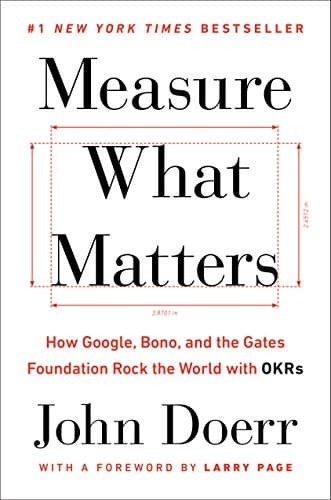
Book details and cover from Google Books.
Ready to read Measure what matters?
Get your copy on Amazon, or listen to it on Audible. We earn a commission if you buy through these links.