
We earn a commission if you buy through these links. Learn more
Me, Myself, and Us
Guide by the Books of the Day editors · Updated · How we write our guides
Brian Little's Me, Myself, and Us argues personality is not fixed: we can act out of character via personal projects and supportive relationships.
What It's About
Me, Myself, and Us is a personality psychologist's attempt to answer a question many readers have felt: why do we sometimes feel like strangers to ourselves, acting in ways that don't match who we think we are? Brian Little takes the familiar debate between nature and nurture and adds a third angle. He argues that personality is shaped by the traits we inherit, the personal projects we choose to pursue, and the relationships that support or constrain us.
The writing is conversational and anecdote-friendly, mixing research summaries with practical reflection. Little tends to present findings as working ideas rather than settled laws, and he is candid about what the evidence does and doesn't establish. Expect a book that asks you to examine your own life more than one that hands you a system to apply.
Reading it feels less like absorbing a theory and more like a guided self-audit. The tone is warm and reassuring but doesn't flatter. The strongest stretches help you notice when you are acting out of character for good reasons, and when you are stuck in a role you never chose. It rewards slow reading and a willingness to think about your own habits.
Read this if you…
- are curious why you behave differently at work than at home
- want practical ways to balance who you are with what your life demands
- like psychology written for general readers, with research kept in service of everyday questions
Skip it if you…
- want a rigorous, evidence-heavy account of personality measurement or the Big Five
- prefer a structured self-help program with exercises, checklists, and steps
Key Ideas
- 1
Free traits: acting out of character on purpose
Little separates core traits, which are relatively stable and largely inborn, from free traits, the behaviors we can adopt deliberately, such as being outgoing at a networking event. This makes personality partly a performance we can direct. The real question becomes how long we can keep it up and whether we can recover afterward.
- 2
Personal projects shape identity and meaning
Rather than focusing only on abstract traits, Little looks at the concrete things people are working toward, whether a garden, a thesis, or caring for an aging parent. These projects link traits to a sense of purpose. They show how much of our identity is organized around what we are trying to do, not just who we are.
- 3
Restorative niches let us recharge
People need places, roles, or relationships where they can be themselves without constant effort. Little calls these refuges restorative niches. The idea is that sustaining free traits in demanding settings requires time and space to recover, and that ignoring this need is a common source of burnout and inauthenticity.
- 4
The social self: other people shape us
The book's third layer, captured in its title, concerns the people around us. Relationships and communities are part of how personality is expressed and tested. Little suggests that understanding ourselves means looking at the networks that encourage or limit our projects, not only at our inner lives.
Limitations
Critics may find the framework more suggestive than rigorously tested, and much of the material draws on the author's own research program and examples, so readers wanting a wider survey of the field will need other sources. The book does not trace the history of trait psychology or weigh competing models in depth, and it is not primarily concerned with clinical questions. Some of the advice about managing a demanding life can feel general.
Questions Readers Ask
- Is Me, Myself, and Us still relevant?
- The core questions about traits, identity, and social context remain central to personality psychology, and the book's ideas are still widely discussed. Its research examples are older, though, so if you care about a specific topic, check more recent work alongside it.
- How does it compare to Susan Cain's Quiet?
- Cain focuses mainly on introversion and why it is undervalued. Little is broader, treating introversion and extraversion as one set of traits among many and emphasizing how people deliberately act against type. Choose Cain for a focused case for introverts, and Little for a wider view of identity.
- Published
- 2014
- ISBN
- 9781491551813
- Difficulty
- intermediate
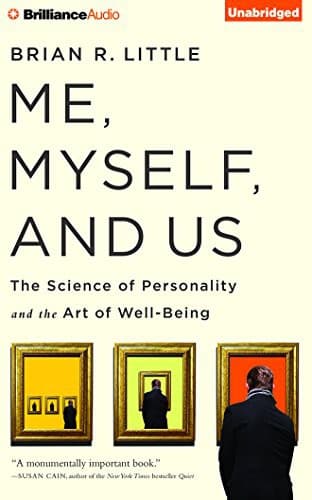
Book details and cover from Google Books.
Ready to read Me, Myself, and Us?
Get your copy on Amazon, or listen to it on Audible. We earn a commission if you buy through these links.