
We earn a commission if you buy through these links. Learn more
Maus II
Spiegelman's second Maus volume turns his father's Auschwitz survival into a harder story about what comes after, and about the cost of telling it.
What It's About
Maus II is the second volume of Art Spiegelman's comic about his father, Vladek, a Polish Jew who survived the Holocaust, and about the long, often exhausting process of getting that story out of him. The first volume ended in the camps. This one covers Vladek's later ordeals and his life after liberation, but the past is never presented on its own. It keeps running into the present, where Art is in his late thirties, living in New York with his wife, and struggling to finish the project while his father remains stubborn, thrifty, and often hard to be around.
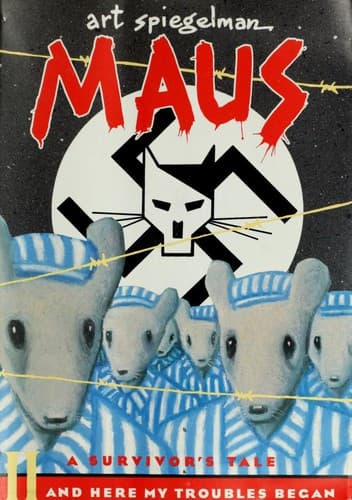
The approach is what makes the book distinctive. Spiegelman draws Jews as mice, Nazis as cats, Poles as pigs, and Americans as dogs, a device that can feel stark at first and then becomes a way of thinking about identity, propaganda, and who gets to be a person in a story. He also builds comics within the comic, so the form keeps questioning its own honesty and how a child of survivors can represent suffering he did not directly live through.
Reading it is slow, uncomfortable, and sometimes darkly funny. The drawings are simple and the pages are dense with dialogue, so you move through it steadily rather than rushing. The emotional payoff is partial and unresolved, which is part of the point.
Read this if you…
- want a Holocaust story that focuses on what happens after the camps, not only on the camps themselves
- are interested in how comics can handle memory, testimony, and self-consciousness
- can handle a bleak, emotionally demanding book that rewards patience
Skip it if you…
- want a complete, self-contained narrative with a clear emotional resolution
- are looking for a light or fast read, since the material is heavy and the pacing is deliberate
Key Ideas
- 1
Survival does not end at liberation
The book argues that surviving the camps was only the start of a long struggle. Vladek's postwar years, including his money worries, his second marriage, and his fears, show how the damage persisted and shaped the people around him, long after the war was officially over.
- 2
The problem of telling a father's story
Art repeatedly confronts how hard it is to record a testimony that is shaped by memory, self-interest, and pride. The tension between what Vladek says and what Art needs from him drives much of the book and raises honest questions about whether any survivor account can be neutral.
- 3
Animal masks as a moral device
The cat, mouse, pig, and dog figures are a deliberate choice that makes readers notice how national and racial categories are constructed and used. Spiegelman keeps returning to the masks, sometimes questioning them, so the allegory itself becomes part of the argument.
- 4
Inherited trauma in the second generation
Art's own depression, anxiety, and strained family life show what it is like to grow up as the child of survivors. The book suggests that the Holocaust reached his life through daily habits, arguments, and silences rather than only through the history books.
- 5
Survival traits that look ugly afterward
Vladek's frugality, control, and suspicion helped him survive, but they make him difficult to love in peacetime. The book does not excuse or simplify him, and that refusal to make him either saint or villain is one of its most valuable features.
Limitations
Some readers find the animal allegory reductive or uncomfortable, especially the way it sorts people into nationalities. The book is also narrow in scope: it is one family's story, and it does not try to survey the wider history of the Holocaust or Polish Jewish life. Vladek can be hard to sympathize with, and some critics feel the frame story about Art's own struggles takes up space that could have gone to the father's experience. It also works best after reading the first volume, so it is not a good entry point on its own.
Questions Readers Ask
- Do I need to read Maus I before Maus II?
- Yes, you should. Maus II continues directly from the first volume, including its characters, its frame story, and its unresolved tensions. Reading it alone would leave much of the emotional and structural logic unclear. The two volumes are usually published together and work best as one long book.
- Is Maus II still worth reading today?
- Yes. Its questions about testimony, inherited trauma, and how stories about atrocity get told remain central in discussions of memory and history. The comics form also still feels fresh, and the book is often assigned in schools and university courses for those reasons.
- How does Maus II compare to a conventional Holocaust memoir?
- A conventional memoir usually offers a single voice and a more linear arc. Maus II is more fragmented and self-aware, moving between past and present and repeatedly showing the author's doubts. If you want a more traditional testimony with fewer formal experiments, you may prefer a standard memoir instead.
- Published
- 1991
- ISBN
- 9780394556550
- Difficulty
- intermediate
- Category
- Biographies
Book details and cover from Google Books.
Ready to read Maus II?
Get your copy on Amazon, or listen to it on Audible. We earn a commission if you buy through these links.