
We earn a commission if you buy through these links. Learn more
Maud Martha
Guide by the Books of the Day editors · Updated · How we write our guides
Brooks's only novel is a sequence of sharp, luminous vignettes about a Black woman's ordinary life in Chicago, and it rewards readers who like language as much as plot.
What Creators Say About Maud Martha
2 creators reviewed Maud Martha on YouTube between 2022 and 2023, with 1.6K views between them. Their opinions are their own; we picked these reviews, we didn't write them.
What It's About
Maud Martha, published in 1953, is Gwendolyn Brooks's only novel, and she was already a Pulitzer-winning poet when she wrote it. It does not look like a conventional novel. It runs as a sequence of short, separate sections, many only a paragraph or two long, that trace the life of a Black girl and then a woman in Chicago, from childhood through marriage and motherhood.
The prose is lyrical and compressed. It moves between close third person, interior thought, fragments, and dreamlike passages, and Brooks's poet's ear shows in the rhythm and the precise choice of images. Reading it feels less like following a plot than like being let into someone's private attention, where a remark in a store, a glance at a party, or a quiet moment at home carries as much weight as any big event.
The book is quiet rather than dramatic. Its pressure comes from daily racism, colorism within a Black family, and the work of holding onto self-respect when the world keeps sizing you up. Expect restraint and wry observation rather than fast momentum. The reward is a portrait of an inner life that the outside world barely notices.
Read this if you…
- want a literary novel that reads like a series of sharp, luminous snapshots
- are interested in how race and skin color shape everyday life in mid-twentieth-century America
- enjoy language-driven fiction and prose that reads with a poet's care
Skip it if you…
- need a fast plot with rising tension and a clear arc toward a climax
- want a detailed historical account of Chicago politics or the civil rights movement
Key Ideas
- 1
Ordinary days as the real subject
Brooks treats small, unremarkable moments as the center of the book. Shopping, household routines, conversations, and passing encounters are given the same attention a conventional novel would give to turning points, so the emotional stakes build through accumulation rather than a single climax.
- 2
Colorism and the sting of family comparison
Skin color shapes how Maud Martha is seen by relatives and strangers alike. The book shows how a family can absorb and repeat the hierarchies of the wider society, and how a young woman learns to measure herself against standards she never chose.
- 3
Protecting an interior life from outside judgment
A recurring concern is how to keep a sense of self when others define you by appearance, race, or class. Maud Martha's inner voice, with its humor, irritation, and daydreams, is the book's main form of resistance and self-definition.
- 4
Form shaped by a poet's sensibility
The vignette structure, the compressed sentences, and the attention to sound mark this as the work of a poet. Readers who enjoy how a line can carry emotion through rhythm and imagery will find the prose itself a central pleasure, not just a vehicle for the story.
Limitations
The vignette structure can feel fragmentary, and the emotional arc is subtle enough that some readers find the book elliptical or its protagonist frustratingly passive. The novel stays tightly within one woman's inner world, so the wider range of Black women's lives and the larger social history of its period sit outside its frame. Its 1950s setting also carries attitudes about gender, class, and respectability that some readers will find dated and that benefit from historical context.
Questions Readers Ask
- Is Maud Martha a good first Gwendolyn Brooks book?
- Brooks is best known as a poet, and her collection Annie Allen won the Pulitzer Prize in 1950. Maud Martha is her only novel and shares the same sensibility, so it works well if you want to see her talent in prose. Readers who are new to her work might also enjoy sampling her poetry alongside it.
- How does it compare to Toni Morrison's The Bluest Eye?
- Both novels deal with Black girlhood, colorism, and beauty standards in mid-century America. Morrison's book is more sustained and plot-driven, built around a tragic central event. Brooks's book is looser and more impressionistic, focused on small everyday moments. Readers who want a conventional novel with a strong emotional build may prefer Morrison.
- Is Maud Martha still relevant today?
- Yes. Its questions about colorism, respectability, and how Black women manage being underestimated remain widely discussed. Some period details and attitudes are dated, so a little historical context makes the book easier to appreciate, but its concerns about self-worth and judgment still resonate.
- Published
- 1953
- ISBN
- 9780404113681
- Difficulty
- intermediate
- Category
- Fiction
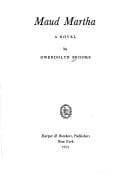
Book details and cover from Google Books.
Ready to read Maud Martha?
Get your copy on Amazon, or listen to it on Audible. We earn a commission if you buy through these links.