
We earn a commission if you buy through these links. Learn more
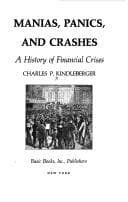
Manias, panics, and crashes
by Charles Poor Kindleberger, Robert Aliber
A readable history of bubbles and financial panics that gives you a practical template for spotting how booms turn into busts, from Dutch tulips to 1929.
What It's About
Charles Kindleberger, an economic historian, spent much of his career cataloguing financial manias across several centuries and countries. The book is built around a sequence he traces through these cases: an outside shock opens a window of profit, credit expands, speculation feeds on itself, insiders begin selling, and confidence collapses. Robert Aliber, who revised later editions, kept that framework while extending the record to more recent episodes.
The style is narrative rather than mathematical. Kindleberger moves from one episode to the next with concrete detail about speculators, bankers, and officials, and he cares more about recurring patterns of human behavior than about precise models. Reading it feels like being walked through a long set of case files by someone who has seen the same story many times and enjoys noticing the variations.
The experience is part history lesson and part warning. Chapters are fairly self-contained, so you can dip in by era. You will come away with a vocabulary for discussing crises and a skeptical habit of asking whether a boom is being fueled by credit that few people are watching closely.
Read this if you…
- want a concise historical framework for understanding bubbles and panics
- follow financial news and want context for why booms keep repeating
- prefer narrative history to econometric models or dense theory
Skip it if you…
- want a current, data-driven guide to modern markets, crypto, or post-2008 regulation
- need technical detail on derivatives, monetary mechanics, or risk modeling
Key Ideas
- 1
A shock starts the cycle
A new technology, a war, a financial innovation, or a policy change alters expected profits and draws investors in. Kindleberger treats the shock as the spark rather than the bubble itself, which is why he sees early booms as reasonable. Credit expansion then amplifies the initial enthusiasm.
- 2
Credit fuels the mania
When money and credit grow quickly, prices can drift far from underlying value. Speculators buy with borrowed funds expecting to resell at higher prices, so the rise becomes self-reinforcing until the marginal buyer disappears. The book shows how this logic repeats across very different markets.
- 3
Insiders leave first, then panic spreads
Kindleberger describes how those closest to a market start taking profits, followed by distress among borrowers and a scramble for cash. Falling prices make debts harder to service, and the rush for liquidity turns an ordinary correction into a crash that spreads beyond the original market.
- 4
The case for a lender of last resort
Drawing on Walter Bagehot's nineteenth-century advice, the book argues that a central bank should supply liquidity during a panic to stop a chain of failures. It also notes the moral hazard of rescuing reckless lenders, a tension that remains one of the most debated policy questions.
- 5
Crises recur because memory fades
Each generation tends to believe that this time is different, and regulatory fixes often address the last crisis rather than the next one. Kindleberger's point is that the instruments change while the underlying human patterns stay remarkably stable.
Limitations
Critics argue the model is more descriptive than predictive. The displacement, mania, and panic sequence fits past cases well, but it is less clear which early signs reliably separate a dangerous boom from a healthy one. Some readers find the narrative repetitive, and the book leans on well-known episodes rather than systematic evidence across many cases. Because it has been revised over decades, coverage of recent crises varies by edition, so check which version you are buying if you want the latest material. Its policy prescriptions also reflect mid-century assumptions about central banking.
Questions Readers Ask
- Is Manias, Panics, and Crashes still relevant after 2008?
- Largely, yes. The core pattern of credit-fueled speculation followed by a rush for liquidity fits the 2008 crisis and many later episodes well. Some specifics, such as shadow banking and modern crypto markets, are not covered in depth, so pair it with more recent analysis for those topics.
- How does it compare with Reinhart and Rogoff's This Time Is Different?
- Reinhart and Rogoff rely on large cross-country datasets and quantitative patterns across centuries. Kindleberger offers a narrower, more narrative account built around one explanatory sequence. Read Kindleberger first for the story and the framework, and turn to Reinhart and Rogoff if you want the statistics.
- Do I need an economics background to read it?
- No. The writing is accessible and avoids heavy mathematics. Some familiarity with basic ideas like credit, interest rates, and central banks helps, but the historical episodes carry much of the explanation.
- Published
- 1978
- ISBN
- 9789509122147
- Difficulty
- intermediate
- Category
- Finance
Book details and cover from Google Books.
Ready to read Manias, panics, and crashes?
Get your copy on Amazon, or listen to it on Audible. We earn a commission if you buy through these links.