
We earn a commission if you buy through these links. Learn more
Making work visible
Guide by the Books of the Day editors · Updated · How we write our guides
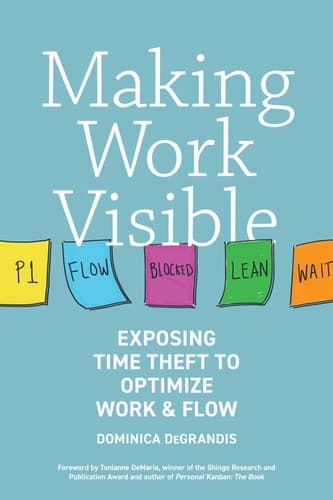
Dominica DeGrandis shows how invisible work, like half-finished tasks and interruptions, quietly drains team productivity, and how simple visual boards can bring it into view.
What Creators Say About Making work visible
2 creators reviewed Making work visible on YouTube between 2018 and 2021, with 1K views between them. Their opinions are their own; we picked these reviews, we didn't write them.
What It's About
Making Work Visible is aimed at people who run or work on IT and knowledge-work teams, where output is hard to measure and busyness can pass for progress. DeGrandis argues that much of what slows a team is not the planned work on the board but the work nobody tracks: unplanned requests, tasks started and left unfinished, and waiting on other people. She calls these hidden drains time thieves.
Her approach is practical rather than theoretical. She draws on Kanban and lean thinking and leans on visual tools, such as boards and work-in-progress limits, to make hidden work observable so a team can discuss it. The emphasis is on small experiments a team can try next week rather than sweeping reorganizations.
Reading it feels like a long conversation with an experienced practitioner. It is short and accessible, and its most useful passages prompt you to look honestly at your own team's board. Expect examples drawn mostly from software and operations work; if your job looks very different, you will need to translate the ideas yourself.
Read this if you…
- run or work on a software, IT, or operations team and feel busy without clear progress
- want practical, low-cost changes rather than a large methodology overhaul
- already know basic Kanban and want a deeper look at why visual boards work
Skip it if you…
- want a theory-heavy book on productivity, management, or organizational behavior
- work in a field with little interruption or handoff, such as solo creative or research work
Key Ideas
- 1
Work you cannot see still costs time
DeGrandis's central claim is that teams lose capacity to work that never appears on any plan: urgent requests that arrive by chat, follow-ups nobody wrote down, and fixes for problems created earlier. Because this work is invisible, it is never estimated or weighed against priorities. Making it visible is the first step toward deciding what to do about it.
- 2
Half-finished work hides the true cost
Tasks that are started but not completed tie up people and attention long after they stop feeling urgent. The book shows how too many open items encourage constant switching, which makes every task slower and more error-prone. Limiting how much is in progress at once is presented as a direct way to reclaim that lost time.
- 3
Unplanned requests break flow
Interruptions are treated as a structural problem rather than a personal discipline issue. DeGrandis explores how interruptions arrive, who absorbs them, and why teams often accept them without discussion. Naming them on the board gives a team a shared way to see the pattern and negotiate how to handle them.
- 4
Visual boards make tradeoffs discussable
The book's most practical theme is that a board is a conversation tool, not just a status display. When hidden work is drawn out, people can talk about tradeoffs in concrete terms instead of arguing from memory. The value comes from the team looking at the board together and changing their habits as a result.
Limitations
Much of the material assumes a software or IT setting, and the examples of boards and workflows may feel narrow for teams in healthcare, sales, education, or the public sector. Readers looking for rigorous research on productivity will find mostly practitioner experience rather than controlled studies. Some terminology and tooling reflects the Kanban practice of its time, so newer team software may need to be mapped onto the ideas by hand.
Questions Readers Ask
- Is this book only useful for software teams?
- No, but it is written for them. The core ideas about hidden work, interruptions, and too much in progress apply to any team with shared tasks. You may need to translate the examples, especially the board and workflow illustrations, into your own setting, which is usually a short and worthwhile exercise.
- How does it compare to The Phoenix Project?
- The Phoenix Project tells its DevOps ideas through a novel, which makes it engaging but indirect. Making Work Visible is a plainer, more instructional guide focused on one problem: how hidden work drains a team. If you want a story, start with Phoenix; if you want a practical toolkit, this is the more direct choice.
- Is the advice still relevant with newer tools?
- The underlying principles hold up well: hidden work costs time, too much in progress slows everyone down, and shared visibility improves decisions. The specific board setups and tool references may feel dated, but you can apply the thinking in any project tracker or on a simple whiteboard.
- Published
- 2017
- ISBN
- 9781942788188
- Difficulty
- beginner
- Category
- Psychology
Book details and cover from Google Books.
Ready to read Making work visible?
Get your copy on Amazon, or listen to it on Audible. We earn a commission if you buy through these links.