
We earn a commission if you buy through these links. Learn more
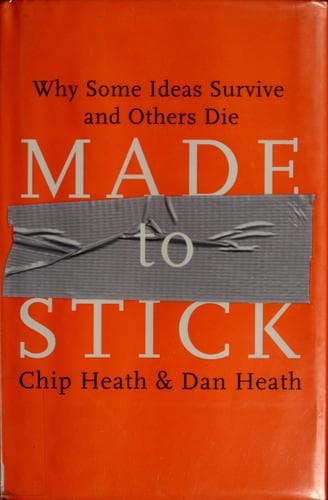
Made to stick
A practical, anecdote-driven guide to why some ideas stick and most fade, offering six principles you can use to make your own messages memorable.
What It's About
Made to Stick asks a simple question: why do some ideas lodge in memory while most evaporate within minutes? Chip and Dan Heath approach it as a practical problem for anyone who has to communicate, whether that means pitching a product, leading a team, or teaching a class. They gather examples from urban legends, political speeches, advertising, and classrooms, then compare weak versions of a message with stronger ones and explain what changed.
The framework rests on six principles they summarize as SUCCESs: simplicity, unexpectedness, concreteness, credibility, emotion, and stories. Each gets its own section with worked examples. A recurring thread is the curse of knowledge, the trap where experts forget what it feels like not to know something, and therefore fail to explain it well. The prose is brisk and conversational, with short chapters, memorable phrasing, and frequent demonstrations.
Reading it feels more like a workshop than a research monograph. You will likely come away with a sharper sense of why your own presentations or pitches fall flat, plus a set of questions to test a message before you send it. It is most useful as a hands-on guide rather than a deep dive into cognitive science.
Read this if you…
- write presentations, pitches, or marketing copy and want a clear checklist for making them land
- lead a team or teach a class and struggle to get important points to stick
- prefer concrete examples and short chapters over dense theory
Skip it if you…
- want rigorous research on memory and psychology with detailed experimental evidence
- are looking for a deep treatment of the ethics of persuasion or of manipulation in messaging
Key Ideas
- 1
The curse of knowledge
Once you know something, it becomes hard to imagine not knowing it. The authors argue that this gap between what the speaker knows and what the listener knows is the main reason experts communicate poorly, and that recognizing the gap is the first step toward fixing it.
- 2
Find the core and keep it simple
A sticky message is stripped down to its most important point. The book urges you to decide what you most want people to remember and to cut the rest, rather than presenting a long list of priorities that nobody retains.
- 3
Concrete images beat abstract claims
Vivid, specific details are easier to recall than general statements. The authors show how turning an abstract goal into a tangible picture helps people grasp it and act on it, while credibility comes from details people can check or picture for themselves.
- 4
Emotion and stories drive action
People are more likely to care about a message that makes them feel something or that they can mentally rehearse through a story. The book explains how narratives let listeners simulate a situation, which helps them remember the lesson and apply it later.
- 5
Break patterns to capture attention
Unexpected elements grab attention and create curiosity that keeps people engaged. The authors suggest surprising listeners, then holding their interest by revealing information gradually, so the message is not just noticed but pursued.
Limitations
Some critics find the book more anecdotal than rigorous. Its principles rest largely on illustrative case studies, and the authors do not always separate the evidence for their claims from the stories that make them memorable. Several examples reflect the business and media landscape of the mid-2000s, so some references feel dated. The book also says little about how stickiness can be misused, such as in misleading advertising or propaganda. Readers looking for academic depth may want to supplement it with more research-focused works.
Questions Readers Ask
- Who is Made to Stick best for?
- It suits anyone who regularly needs to explain ideas to others, including managers, marketers, teachers, nonprofit staff, and entrepreneurs. Its examples are accessible and its advice is immediately usable, so it does not require any background in psychology or business theory to follow.
- Is Made to Stick still relevant?
- The core principles, especially the curse of knowledge and the value of concrete, emotional stories, remain useful. Some examples and cultural references are dated, but the underlying advice about clarity and simplicity has held up well for communicators in most fields.
- How does it compare to Influence by Robert Cialdini?
- Influence focuses on the psychological principles that drive persuasion and compliance, backed by extensive research. Made to Stick is narrower and more practical, concentrating on how to make a message memorable and clear. Readers who want the science of persuasion may prefer Cialdini, while those who want a communication checklist may prefer the Heaths.
- Published
- 1998
- ISBN
- 9780812982008
- Difficulty
- beginner
- Category
- Business
Book details and cover from Google Books.
Ready to read Made to stick?
Get your copy on Amazon, or listen to it on Audible. We earn a commission if you buy through these links.