
We earn a commission if you buy through these links. Learn more
Lucky Jim
Guide by the Books of the Day editors · Updated · How we write our guides
Kingsley Amis's 1954 campus comedy about a hapless junior lecturer who would rather be anywhere else is one of the funniest put-downs of academic pretension in English fiction.
What Creators Say About Lucky Jim
2 creators reviewed Lucky Jim on YouTube between 2015 and 2021, with 12.7K views between them. Their opinions are their own; we picked these reviews, we didn't write them.
What It's About
Lucky Jim follows Jim Dixon, a junior history lecturer at a provincial English university. He holds a temporary post he badly wants to keep, and he has to get along with Professor Welch, the head of department, whose cultivated airs Jim finds almost unbearable. Much of the book's energy comes from Jim's daily effort to look like a serious scholar of medieval history while privately having no interest in it at all.
Amis writes in close third person and mostly stays inside Jim's head. The humour comes from the distance between what Jim thinks and what he is forced to say and do. The dialogue is sharp, the set pieces are built around social embarrassment, bad manners and too much drink, and the prose is quick and plain rather than ornate.
Reading it feels like watching a man lose his composure in public while you quietly cheer him on. The book is short, very funny, and slightly bleak underneath, with real attention to class, academic vanity and the awkwardness of trying to get ahead. It still feels fresh, even though its university world and social attitudes now seem remote.
Read this if you…
- enjoy sharp, funny novels about awkward social situations
- are interested in British postwar fiction and the class anxieties behind it
- like comic protagonists who are petty, honest and easy to root for
Skip it if you…
- need a plot with a strong forward drive and high stakes
- find the snobbery and dated attitudes of the period hard to tolerate
Key Ideas
- 1
An outsider mocking the academic establishment
Jim is an unlikely insider in a university he does not respect. His view of the department, its rituals and its self-importance gives the novel its bite. He is not a rebel with a plan. He is simply a man who cannot stand the performance he is expected to put on, and the book treats that irritation as a serious source of comedy.
- 2
Pretension as the main target
Amis is less interested in ideas than in people who use culture as a costume. Welch and his circle talk about art, music and taste in ways meant to impress rather than to understand. Jim's contempt for this posing drives many of the scenes, and the satire works because the targets seem recognisably real.
- 3
Class and the scramble for security
Jim is anxious about money, status and his future in a way that his more comfortable colleagues are not. The novel shows how much of his behaviour is shaped by the need to keep a job and avoid falling back. Beneath the jokes, it is a portrait of ambition in postwar Britain, with the fear of failure always close by.
- 4
Quick, plain comic prose
Amis writes clean, economical sentences and lets the situations do the work. Long descriptions are rare. Instead, the comedy comes from timing, dialogue and escalating mishaps. For readers who enjoy comic fiction that moves briskly and rewards close attention to who says what, the style is a large part of the pleasure.
- 5
Rebellion that stays mostly inside Jim's head
Jim's resistance to his surroundings is real but mainly takes the form of private mockery and occasional outbursts. The book is funny about this, yet it also suggests how hard it is to step out of a system you depend on. That tension keeps the comedy from being purely light.
Limitations
The novel is very much of its time. Its university, its class assumptions and its ideas about gender feel dated, and women characters are mostly seen through Jim's frustrated and often unkind eyes. Some readers find the satire of Welch and his circle broad, and the comedy relies heavily on a single point of view, so other characters rarely get room to surprise us. The plot is also slight, which suits a short comic novel but may disappoint readers wanting more story.
Questions Readers Ask
- Is Lucky Jim still funny today?
- For many readers, yes. The humour depends mostly on character, timing and embarrassment, which travel well. The academic world and some attitudes are dated, so you will need to read them as a period piece. Still, Jim's struggle to keep his composure in front of pompous people is easy to recognise.
- How does Lucky Jim compare to Evelyn Waugh's comic novels?
- Both are satirical comedies about social pretension, but Waugh tends to be more detached and elegant, while Amis is closer to his protagonist and more openly ill-tempered. If you like Waugh's polish, Amis may feel rougher and more personal, which some readers find more involving.
- Published
- 1953
- ISBN
- 9780736601955
- Difficulty
- beginner
- Category
- Fiction
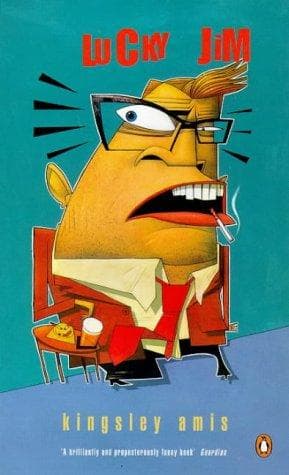
Book details and cover from Google Books.
Ready to read Lucky Jim?
Get your copy on Amazon, or listen to it on Audible. We earn a commission if you buy through these links.