
We earn a commission if you buy through these links. Learn more
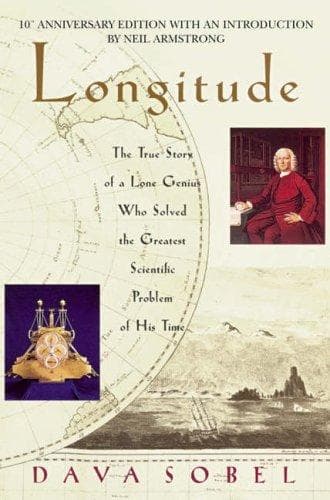
Longitude
by Dava Sobel, William J. H. Andrewes
Dava Sobel turns the eighteenth-century hunt for a reliable sea clock into a gripping story of one self-taught craftsman against the scientific establishment.
What It's About
Longitude tells the story of John Harrison, a self-taught English carpenter and clockmaker who spent much of his life trying to build a timekeeper accurate enough to let ships at sea work out their east-west position. The problem was urgent. Lost ships and drowned crews were a constant cost to a maritime Britain, and Parliament offered a large reward, administered by a government board, for a workable solution.
Sobel writes it as narrative biography rather than a textbook. She moves between Harrison's workshop, his long campaign for recognition, and the astronomers and officials who judged his claims, keeping the pace of a story about a single stubborn craftsman pitted against an establishment. The writing is brisk and accessible, and it explains the technical difficulty without equations, though it is not a manual of how clockwork functions.
Reading it feels like following a long dispute and a mechanical puzzle at the same time. You get a clear sense of why the problem was so hard, why clocks that kept good time on land failed on a rolling deck, and how much of the struggle was really about who got to decide what counted as proof. It is a short, readable book that leaves a strong impression of one particular human drama.
Read this if you…
- want an accessible history of science that reads like a narrative with a clear protagonist
- are curious how practical engineering problems were solved before modern instruments and institutions existed
- enjoy stories about underdogs fighting entrenched authority and official indifference
Skip it if you…
- want a detailed technical explanation of how marine chronometers were built or how the lunar distance method worked
- prefer an evenhanded account that gives equal weight to all the people involved in the dispute
Key Ideas
- 1
Longitude was a timing problem
Finding latitude at sea was manageable, but longitude depended on knowing the time at a fixed reference point while the ship sailed. Every hour of error in that clock translated into a large distance error. The book makes clear why a portable, dependable timekeeper was the crux, and why the obvious approaches of the day fell short.
- 2
Craft knowledge against theory
Harrison was a craftsman who solved problems through hands-on experiment, not through the mathematical or astronomical training his judges had. Sobel shows how his ideas about materials, friction, and temperature were dismissed by people who trusted theory and the authority of their own methods, and how that gap shaped the whole dispute.
- 3
Rival methods and the astronomers
The main competitor to Harrison's clocks was a method based on measuring the Moon's position against the stars, championed by leading astronomers. The book treats this as more than a technical choice. It is a clash of institutions, reputations, and professional pride, and it helps explain why the clock-maker's case was so hard to win.
- 4
Proof, patronage, and recognition
Sobel uses Harrison's experience to examine how innovation was judged in a period when boards, committees, and royal favor mattered as much as results. The question of whether a working device is enough to earn a reward runs through the book, and the answer it gives is more complicated and frustrating than a simple tale of triumph.
- 5
The cost of persistence
The story is as much about endurance as invention. Harrison's decades of revisions, appeals, and disappointments show what a single inventor can sacrifice for an idea. Readers who enjoy stories of obsession and perseverance will find this the emotional core of the book.
Limitations
The book's strongest criticism is that it frames the story as a clash between a lone genius and a jealous establishment, which simplifies the situation. Critics argue that some officials and astronomers were more open-minded and that the institutional process had legitimate reasons for caution. The narrative also leans on dramatic character portraits, and it does not go deep into the wider maritime, economic, or scientific context of the period. Readers wanting a balanced or technically rigorous account should look elsewhere.
Questions Readers Ask
- Is Longitude suitable for readers without a science background?
- Yes. Sobel avoids mathematics and explains the core problem in plain language, using the story to carry the technical ideas. You do not need prior knowledge of navigation or clockwork to follow the book, though a general interest in history helps.
- Is the book's account of Harrison fully accurate?
- It is a popular narrative and it presents Harrison's side strongly, so some historians consider its portrayal of his opponents one-sided. It remains a well-regarded entry point, but reading a more specialized history alongside it will give you a fuller picture of the dispute.
- Is Longitude still worth reading today?
- Yes, especially as an introduction to how navigation and timekeeping developed. The core story is still compelling, although the account has been challenged in places by later research, so treat it as a strong narrative rather than the final word.
What Creators Say About Longitude
Reviews from readers on YouTube. Their opinions are their own.
- Published
- 1995
- ISBN
- 9781606712764
- Difficulty
- beginner
- Category
- History
Book details and cover from Google Books.
Ready to read Longitude?
Get your copy on Amazon, or listen to it on Audible. We earn a commission if you buy through these links.