
We earn a commission if you buy through these links. Learn more
Lolita
On screen: Lolita (film, 1962)
Guide by the Books of the Day editors · Updated · How we write our guides
A narrator so articulate and seductive that readers must keep arguing with him, Nabokov's novel is one of the most formally dazzling and morally unsettling books in modern fiction.
What Creators Say About Lolita
2 creators reviewed Lolita on YouTube between 2021 and 2024, with 3.1M views between them. Their opinions are their own; we picked these reviews, we didn't write them.
What It's About
Lolita is narrated by Humbert Humbert, a cultured European expatriate who writes from confinement, addressing an unspecified court and, in effect, the reader. He presents his account as a defense, polished and self-justifying, of his obsession with a young girl and of the years he spent with her while travelling across postwar America. The novel's horror lies in the gap between the sophistication of his voice and what he is actually describing.
Nabokov's prose is the main attraction. Sentences are dense with wordplay, allusions, invented names, and deliberate puns, and the narrator treats language as a toy he cannot put down. The experience is more like watching a brilliant performer work an audience than reading a conventional confession. Much of the book's pleasure comes from noticing what the narrator is hiding in plain sight, which also makes it a demanding act of attention.
The book is also a long, sometimes funny, sometimes harrowing read. Its humor is dark and its pace shifts with the narrator's moods, so expect stretches that feel slow followed by sudden jolts of cruelty and comedy. It rewards a second reading more than almost any novel you will pick up.
Read this if you…
- want a novel where the prose is as much a pleasure as the plot
- are happy to work out what a narrator is concealing
- want to understand why this book provokes such intense debate
Skip it if you…
- need characters you can trust or a story that moves quickly
- find the subject of child abuse too painful to read about, even with a critical framing
Key Ideas
- 1
The unreliable narrator as seducer
Humbert addresses the reader as though won over, flattering us into collusion. Nabokov builds the novel so that the charm of the voice is the trap. Readers notice the distance between what he says and what he means, and that discomfort is the point. Pay attention to who he needs to convince and why.
- 2
Aestheticizing abuse and the problem of beauty
The narrator repeatedly reaches for lyrical language when describing things that should provoke revulsion, and the book forces us to ask how style can make harm look like romance. Nabokov does not let beauty excuse anything, even as he makes the prose irresistible. The novel is less an endorsement of its narrator than an examination of how art can be turned into a tool for self-deception.
- 3
Memory, obsession, and the self-made story
Humbert's account is an act of invention. He reshapes his past, elevates a childhood love into a myth, and renames the girl to suit his fantasy, so the reader is left to piece together the real Dolores from the cracks in his story. How much of the book is memory and how much is self-mythology is never settled, and that ambiguity is central to what the novel is about.
- 4
A portrait of postwar America through foreign eyes
The cross-country sections give a sharp, often comic picture of motels, roadside attractions, schools, and small towns in postwar America. Humbert's European eye catches details an American narrator would skip, and his contempt for the culture he moves through is as revealing as his observations. The book works as social satire even when its main subject is darker.
Limitations
Critics have long argued that the wordplay can feel showy and that the narrator's cleverness keeps the emotional stakes at arm's length. Because we see Dolores almost entirely through Humbert's eyes, her inner life is thin, and some readers find that absence troubling rather than deliberate. The subject is also one that demands care: the book has been misread as romance or titillation, and readers who miss its critical design may come away with the wrong lesson.
Questions Readers Ask
- Is Lolita still worth reading today?
- Yes. The novel's concerns with self-justification, the ethics of storytelling, and the way charm can disguise harm feel more relevant than ever. Its prose remains a model of control and wit. Be prepared that its subject is abuse, and that the book's power depends on readers recognizing the narrator's deceptions rather than trusting them.
- How does Lolita compare with Nabokov's other novels?
- Pale Fire, Nabokov's 1962 novel, is the closest comparison: it also depends on an unreliable narrator whose commentary reveals more than he intends. It is more playful and puzzle-like, with less emotional directness. If you loved the voice in Lolita, it is a natural next step; if you wanted the story's momentum, you may find it slower.
- Published
- 1777
- ISBN
- 9781507796238
- Difficulty
- intermediate
- Category
- Fiction
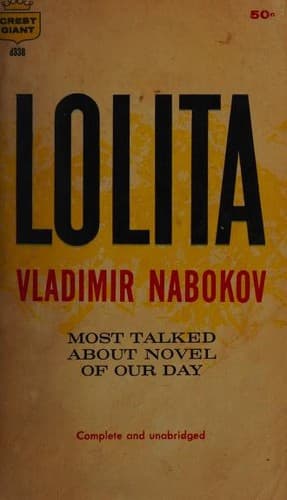
Book details and cover from Google Books.
Ready to read Lolita?
Get your copy on Amazon, or listen to it on Audible. We earn a commission if you buy through these links.