
We earn a commission if you buy through these links. Learn more
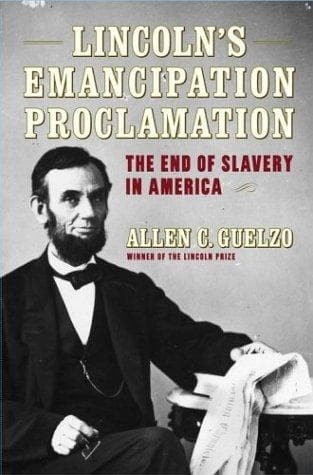
Lincoln's Emancipation Proclamation
A close, legally minded account of Lincoln's path to the 1863 proclamation, showing how military necessity, constitutional limits, and moral conviction shaped it.
What It's About
Allen C. Guelzo's book takes the Emancipation Proclamation seriously as a document, not just a symbol. He traces how Lincoln arrived at the decision during 1862, through cabinet debates, pressure from abolitionists and Radical Republicans, the army's uneven record, and Lincoln's own earlier views on slavery, race, and colonization. The focus stays tightly on the proclamation itself: how it was drafted, why it was issued after Antietam, and the choices that shaped its final wording.
The approach is that of a historian who reads legal and political language closely. Guelzo pays attention to the war-powers reasoning that gave the order its authority, and to the places where the document is narrower than many readers expect. The result is less a celebration than a careful account of how a limited, hedged order became one of the most consequential acts of the war.
Reading it feels like sitting in on a seminar led by a patient expert. It is argumentative and dense in places, assumes some familiarity with the Civil War, and rewards slow reading. Expect analysis and close reasoning rather than narrative drama.
Read this if you…
- want a close, document-centered look at how the Emancipation Proclamation was actually made
- already know the broad Civil War story and want more depth on the legal and political decisions
- are interested in how a wartime measure was justified under the Constitution
Skip it if you…
- want a sweeping narrative of slavery and of Black Americans' own struggle for freedom
- prefer vivid storytelling or a gentle first introduction to Abraham Lincoln
Key Ideas
- 1
Military necessity as the legal foundation
Guelzo examines how Lincoln justified emancipation as a war measure under his powers as commander in chief. This framing mattered both legally and politically, because it let the president act without new legislation while keeping the order tied to the Union's fighting needs. Understanding this logic explains why the document reads the way it does.
- 2
Why the timing after Antietam mattered
The preliminary proclamation came after the Union's contested victory at Antietam in September 1862, and the book explores why that moment made the announcement possible. Guelzo treats the battlefield result as a political opening rather than a simple trigger, showing how Lincoln weighed the army's standing against public and cabinet opinion.
- 3
Limits written into the document
The proclamation did not free every enslaved person in the United States. It applied to areas in rebellion and left out the border slave states and Union-held regions. Guelzo argues that these exemptions were deliberate choices, and that reading them carefully is essential to understanding what the order actually did.
- 4
Lincoln's evolving views on race and colonization
The book tracks how Lincoln's thinking changed over time, including his earlier support for schemes to resettle Black Americans outside the country. Rather than presenting him as fixed in his convictions, Guelzo shows a politician whose position moved under pressure, which makes the final decision easier to understand and harder to simplify.
Limitations
The book is narrow by design, centering Lincoln's decision-making more than the experiences of enslaved people or the proclamation's uneven effect in practice. Readers looking for the lived history of emancipation, including Black agency during the war, will need other sources. Some reviewers find the legal and political argument dry, and the book was written in 2004, so later scholarship on emancipation's implementation has since expanded the picture.
Questions Readers Ask
- Is this a good first book about the Emancipation Proclamation?
- It can be, but only if you already know the basic history of the Civil War and 1860s politics. Guelzo assumes some background and focuses on argument and document analysis. If you are new to the period, a broader overview first will make this book much more rewarding.
- How does it compare to Eric Foner's The Fiery Trial?
- Foner's book covers Lincoln's whole relationship with slavery across his career and the war, while Guelzo narrows to the proclamation itself. Choose Foner for the wider arc and Guelzo for a deeper look at one document and the decisions behind it.
- Published
- 2004
- ISBN
- 9780743262972
- Difficulty
- intermediate
- Category
- Emancipation
Book details and cover from Google Books.
Ready to read Lincoln's Emancipation Proclamation?
Get your copy on Amazon, or listen to it on Audible. We earn a commission if you buy through these links.