
We earn a commission if you buy through these links. Learn more
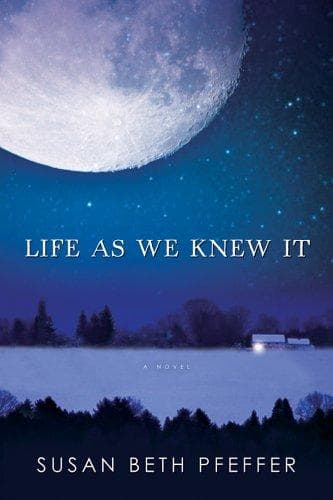
Life As We Knew It
Guide by the Books of the Day editors · Updated · How we write our guides
A teenager's diary tracks one family as a shifted moon upends ordinary life, making a bleak but humane survival story that suits younger readers and anyone wanting a fast, unsentimental read.
What Creators Say About Life As We Knew It
2 creators reviewed Life As We Knew It on YouTube between 2015 and 2016, with 7.1K views between them. Their opinions are their own; we picked these reviews, we didn't write them.
What It's About
Life As We Knew It is a young adult novel told entirely as diary entries by Miranda, a teenager in a small American town. An asteroid strikes the moon and knocks it closer to Earth, and the consequences arrive in waves: enormous tides, volcanic ash that dims the sky, a colder climate, and failing power and food supplies. The book's premise is dramatic, but the story stays focused on a single household.
Miranda's voice is plain and practical. She writes about school closing, counting cans in the pantry, her brother's moods, and the small logistics of getting through each week. The gap between what she notices and what she does not yet understand is where much of the tension lives. Chapters are short and dated, so the book moves quickly, and the dread builds through accumulating details rather than set-piece action.
Reading it feels like being handed someone's private record. The mood is restrained and often grim, and some scenes are hard to read. Hope is present, but it is modest and has to be earned rather than promised. It is written for younger teens, so it avoids graphic excess, and that restraint is part of its strength.
Read this if you…
- want a survival story that stays close to one family's daily struggle
- are a younger teen ready for a bleak but humane apocalypse novel
- want a fast read that builds dread through small, accumulating details
Skip it if you…
- want a scientifically rigorous or technically detailed disaster story
- need a wide cast or a large-scale, action-driven narrative
Key Ideas
- 1
Ordinary routines as the measure of catastrophe
The disaster is felt through household logistics: meals, weather, schoolwork, and who is responsible for what. Miranda's attention to the mundane makes the collapse feel concrete. The book suggests that large-scale events are experienced first as a long series of small adjustments and losses.
- 2
A diary's limited and honest vantage point
Miranda knows only what reaches her home, so the wider picture comes in fragments of rumor, radio, and news. Readers often understand more than she does, which creates a steady undercurrent of unease. The format also means the book never pauses to explain the science in detail.
- 3
A family under sustained strain
Parents, siblings, and Miranda herself are pushed into new roles, and the book examines how relationships bend and sometimes crack. Its attention to who carries the burden and how resentment and love sit side by side gives the story its emotional weight.
- 4
Hope that refuses easy comfort
The novel does not offer a neat rescue. Resilience here is practical, incremental, and sometimes uncomfortable. That refusal to promise rescue is what makes the ending of the first book feel earned rather than cheap, while leaving space for the reader's own response.
- 5
Astronomy as launching point, not lesson
The celestial event is the premise that sets everything in motion, not a subject to be studied. If you want a rigorous account of the physics or a detailed picture of the global response, you will need to look elsewhere. The book's interest is in what happens to people.
Limitations
The science is a springboard rather than a source of accuracy, and readers who know astronomy or climatology will find the premise and its effects loosely handled. The diary format keeps the world off-page, so the broader societal response, government, and international dimensions are mostly rumor. Some critics find Miranda's voice more functional than distinctive, and the family dynamics can feel schematic. The book is also deliberately restrained in its violence and despair, which some readers will find either too gentle or too bleak for their taste.
Questions Readers Ask
- Is Life As We Knew It only for teenagers?
- It is written for young adult and middle-grade readers, with a plain style and short chapters. Many adults read it quickly and appreciate its focus on family and daily life. If you are an adult looking for literary depth or scientific detail, you may find it lighter than you want, but as a fast, emotionally direct survival story it works well at any age.
- How does it compare to The Road by Cormac McCarthy?
- Both are bleak survival stories centered on a small group, but The Road is sparer, more lyrical, and written for adults. Life As We Knew It is more accessible, with a teenage narrator and a diary structure that makes it quicker to read. Choose The Road for literary intensity; choose this if you want a gentler entry point into the genre.
- Published
- 2006
- ISBN
- 9780739336830
- Difficulty
- beginner
- Category
- Children's Books
Book details and cover from Google Books.
Ready to read Life As We Knew It?
Get your copy on Amazon, or listen to it on Audible. We earn a commission if you buy through these links.