
We earn a commission if you buy through these links. Learn more
Lies My Teacher Told Me
Guide by the Books of the Day editors · Updated · How we write our guides
A sharp, still-provocative look at how American high school history textbooks sand off conflict and controversy, and why that matters for anyone who thinks they already know the national story.
What Creators Say About Lies My Teacher Told Me
2 creators reviewed Lies My Teacher Told Me on YouTube between 2022 and 2024, with 10.8K views between them. Their opinions are their own; we picked these reviews, we didn't write them.
What It's About
James W. Loewen, a sociologist, examined a dozen widely used American high school history textbooks and asked a simple question: what do they leave out, and why? His answer is that many books smooth the past into a story of steady national progress, with admirable heroes, few real arguments, and ordinary people who rarely cause trouble.
The book works topic by topic through episodes students usually meet in brief, tidy form, including early encounters between Europeans and Native Americans, slavery, Reconstruction, and the civil rights era. Loewen compares what the textbooks say with the historical record and the scholarship, and he is blunt about the commercial pressures that push authors and publishers toward blandness and offense avoidance.
Reading it feels like listening to a brisk, argumentative lecture rather than a dry survey. The tone is punchy and sometimes sarcastic, written for teachers and general readers alike. You finish with a sharper sense of how historical narratives get shaped, a healthy suspicion of any neat textbook account, and a practical reason to seek out more detailed sources.
Read this if you…
- want to understand why school history often feels like a list of dates and flattering stories
- are curious how a historian-minded critique of textbooks changes the way you read any national narrative
- teach history, or help a young reader, and want a clear case for more demanding source material
Skip it if you…
- want a fresh, balanced survey of American history rather than an argument about what textbooks got wrong
- prefer a gentle, celebratory account of the nation's past and find critical framing unpleasant
Key Ideas
- 1
Textbooks are designed to avoid offense
Loewen argues that textbooks are shaped by the need to sell across many states and school boards. The result is a cautious, least-common-denominator text that avoids anything likely to provoke complaint, even when the evidence points toward a harder and more contested story.
- 2
Heroic narratives crowd out real conflict
Many textbooks frame American history around admirable leaders and steady progress. Loewen shows how this approach strips out disputes, dissent, and the decisions that were genuinely contested at the time, leaving students with a flattened picture of how change actually happened.
- 3
Race and Native history are routinely simplified
A recurring theme is how textbooks handle Native peoples, slavery, and race. Loewen contends that these subjects are often reduced to brief, comfortable summaries that miss the scale of violence, the arguments of the period, and the perspectives of those most affected.
- 4
Why the problem persists despite good scholarship
Loewen does not blame bad intentions alone. He describes how the structure of the textbook market, the pressure to cover everything superficially, and the reluctance to challenge received wisdom keep weak narratives in print even as historians have revised their views.
Limitations
The book is largely a critique rather than a complete alternative curriculum, so readers looking for a full replacement history will need other sources. Its focus on textbooks from the early 1990s means some specific claims have been overtaken by later editions and newer scholarship. Critics also argue that Loewen sometimes presses his points harder than the evidence strictly allows, and that his tone can feel repetitive or polemical over the course of a long read.
Questions Readers Ask
- Is Lies My Teacher Told Me still relevant today?
- Yes, mainly because its central argument about how textbooks handle conflict, race, and Native history remains a live debate in education. Some specific examples reflect the mid-1990s textbook market, so it is worth reading it as a critique of a method rather than as a current audit of every book on the shelf.
- Who is this book best suited for?
- It suits teachers, parents, students, and general readers who want to think critically about how American history is taught. It is less suited to readers who want a continuous narrative of the past, since the book is organized around arguments about specific episodes rather than a single chronological story.
- Published
- 1994
- ISBN
- 9780613706476
- Difficulty
- intermediate
- Category
- Education
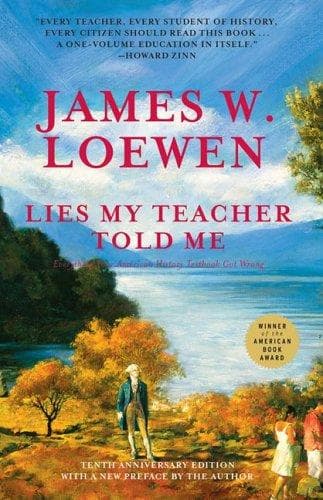
Book details and cover from Google Books.
Ready to read Lies My Teacher Told Me?
Get your copy on Amazon, or listen to it on Audible. We earn a commission if you buy through these links.