
We earn a commission if you buy through these links. Learn more
Let us now praise famous men
Guide by the Books of the Day editors · Updated · How we write our guides
A 1941 portrait of Depression-era Alabama tenant farmers that fuses Agee's torrential prose with Walker Evans's stark photographs, and turns its scrutiny on the writer himself.
What Creators Say About Let us now praise famous men
2 creators reviewed Let us now praise famous men on YouTube between 2020 and 2026, with 667 views between them. Their opinions are their own; we picked these reviews, we didn't write them.
What It's About
Let Us Now Praise Famous Men grew out of a 1936 magazine assignment to document the lives of white tenant farming families in Hale County, Alabama, during the Great Depression. James Agee, a writer, and Walker Evans, a photographer, spent several weeks living alongside three families. The result is less a conventional report than a hybrid: part reportage, part confession, part essay on what it means to look at other people's poverty and to write about it.
Agee's text is the main event, and it is demanding. His sentences are long, layered, and often incantatory. He piles up detail about food, clothing, houses, tools, and bodies, then abruptly turns inward to question his own motives and his right to write about these people at all. Long stretches are given over to close inventory, and the book deliberately resists the tidy arc of a narrative. Evans's photographs are unsentimental and presented as their own body of work rather than as illustrations, so the two sit in productive tension.
Reading it is a slow and sometimes uncomfortable experience. You will feel the author pushing against his own sincerity, and the book rewards patience over speed. It is not a comfortable read, and it does not offer solutions. It asks what attention owes to the people being looked at.
Read this if you…
- are interested in documentary ethics and the responsibilities of writers and photographers
- want an experimental, lyrical account of rural American life in the 1930s
- enjoy dense, poetic prose and are willing to read slowly
Skip it if you…
- want a clear, linear history of the Depression or of tenant farming policy
- find long passages of close description and self-analysis tiring rather than rewarding
Key Ideas
- 1
The guilt of the observer
Agee constantly examines his own position as an outsider with a notebook, asking whether documenting suffering is a form of exploitation. He treats the act of looking as morally loaded, and he refuses to let his own sensibility stand as neutral. This self-scrutiny is the book's ethical engine and the reason it still feels unresolved.
- 2
Dignity through exhaustive, particular detail
Rather than summarizing the families' hardship, Agee catalogs their possessions, meals, work, and surroundings in extraordinary depth. The accumulation is meant to honor these people as particular individuals rather than as a category called poor. Readers may find the method exhausting, but its aim is a kind of respect expressed through precision.
- 3
Photographs and text as rival witnesses
Evans's images and Agee's prose do not simply reinforce each other. The photographs stay still and frontal while the writing moves restlessly, and the gap between them forces the reader to weigh what each form can and cannot capture. The book treats documentary as something that always involves a choice of what to show.
- 4
Style as a form of moral attention
Agee's ornate, rhythmic prose is not decoration. He uses language to slow the reader down and to make ordinary objects and gestures feel weighty. Whether one finds the style moving or overwrought, the book makes a case that how we describe people is inseparable from how we regard them.
Limitations
The book is a snapshot of one county in 1936 and focuses almost entirely on white tenant families, so it says little about Black tenant farmers in the same region and does not attempt a broad social history. Agee's prose is extraordinary but can overwhelm, and some readers find the long meditations on his own feelings indulgent. Its original commercial reception was poor, and its reputation grew mostly after the fact. Read it as a document of its moment and of its author's mind rather than as a complete account of the rural South.
Questions Readers Ask
- Is Let Us Now Praise Famous Men still worth reading today?
- Yes, especially if you care about how writers and photographers represent poverty and vulnerable people. Its questions about who gets to look, and on what terms, remain live ones. The specific social facts are dated, so pair it with more current historical sources if you want a full picture of rural Alabama in the 1930s.
- How does it compare to The Grapes of Wrath?
- Steinbeck's novel uses fiction to build a story around Dust Bowl migrants and a clear emotional arc. Agee's book is nonfiction and far more fragmented, circling its subjects rather than driving toward a plot. Readers who finished Steinbeck and wanted something more formally daring and self-questioning often find Agee the more challenging follow-up.
- Should I read it with the photographs?
- Yes, if you can. Evans's images are integral to the book's effect, and many readers find that the prose and photographs illuminate each other. Look at the pictures on their own terms, then return to the text to see how Agee responds to what the camera did and did not capture.
- Published
- 1941
- ISBN
- 9780330302852
- Difficulty
- advanced
- Category
- History
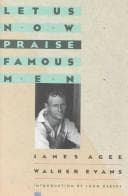
Book details and cover from Google Books.
Ready to read Let us now praise famous men?
Get your copy on Amazon, or listen to it on Audible. We earn a commission if you buy through these links.