
We earn a commission if you buy through these links. Learn more
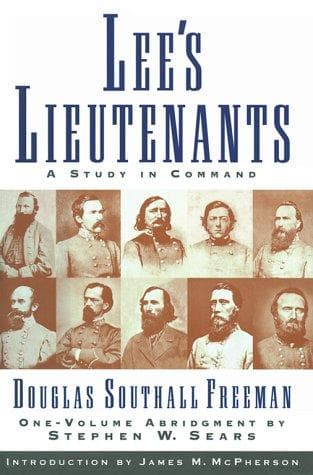
Lee's Lieutenants
A patient, detailed study of Robert E. Lee's top subordinates and how their battlefield decisions shaped the Army of Northern Virginia, rewarding for readers willing to follow the maps.
What It's About
Lee's Lieutenants is a three-volume military history published between 1942 and 1944 by Douglas Southall Freeman, a Richmond newspaper editor who had already written a major biography of Robert E. Lee. Rather than retracing Lee's life, Freeman turns to the men who carried out his orders: Jackson, Longstreet, Stuart, Ewell, A. P. Hill and the other commanders who led the Army of Northern Virginia through its major campaigns. The structure is chronological, moving from Manassas toward Appomattox, and each volume stays close to the battles, the chain of command, and the decisions that shaped them.
The style is that of an exhaustive staff study. Freeman reconstructs orders, troop positions, marches, and reports, often working line by line through official records and the postwar accounts of the men involved, and he weighs conflicting testimony with visible care. Reading it feels less like a sweeping narrative and more like sitting beside a meticulous analyst who wants you to understand why a column arrived late or why a flank gave way.
The experience is demanding and rewarding. Freeman's prose is clear and often elegant, and his judgments of character are direct, sometimes harsh, which keeps the book from being a mere logistics manual. But you need patience for the sequence of movements and for long lists of regiments. Readers who know little about the war will find it a steep yet navigable introduction to command in the field.
Read this if you…
- want a detailed, campaign-level understanding of the Eastern Theater of the Civil War
- are curious how a chain of command works in practice and why orders so often miscarry
- enjoy military history that judges individual commanders rather than just recounting events
Skip it if you…
- want a fast-moving narrative or a book that reads like a novel
- are looking for a balanced account of slavery, politics, and the wider social causes of the war
Key Ideas
- 1
Command depends on the people beneath you
Freeman argues that Lee's effectiveness rested on how he used subordinates: giving broad direction, trusting corps commanders with wide discretion, and stepping in when a subordinate faltered. The book treats leadership as a relationship that succeeds or fails on the ground, not as a set of abstract principles.
- 2
Battles read through the chain of orders
Freeman traces who knew what and when, how messages travelled between headquarters, and why plans often broke down between the army commander and the brigade. Many of the book's most useful lessons come from these small gaps in information and timing, which shaped outcomes as much as courage or tactics did.
- 3
Reputations tested against the record
Postwar memoirs and the Lost Cause tradition had fixed many reputations, especially those of Jackson, Longstreet and Stuart. Freeman checks these claims against documents and reaches verdicts that were controversial at the time and remain debated, which makes the book a useful case study in how military reputations are built.
- 4
Why field leadership shaped the war in Virginia
The book makes a sustained case that the Confederacy's battlefield performance in the east depended heavily on a small group of commanders whose strengths and flaws recur across campaigns. Seeing the same men fail and succeed in different situations helps explain why certain battles turned out as they did.
Limitations
The book is dated in several respects. Freeman was sympathetic to the Confederate cause and to Lee, and his framing sometimes reflects the Lost Cause outlook, particularly in how he assesses Longstreet and Stuart. It relies heavily on Confederate sources and says little about the lives of enslaved people, the home front, or the political questions behind the war. Later historians have revised many of its conclusions, so it is best read alongside more recent scholarship rather than as the last word.
Questions Readers Ask
- Is Lee's Lieutenants still worth reading today?
- Yes, especially for its detailed operational analysis and its study of command. Its interpretive judgments are dated and often contested, so pair it with newer work on the Eastern Theater. A shorter one-volume abridgment, edited by Stephen Sears, is available if the full three volumes feel like too much.
- How does it compare to Freeman's R. E. Lee biography?
- The biography focuses on Lee as a person and leader across his whole life. Lieutenants shifts attention to the subordinates and to the campaigns themselves, so it is more operational and less personal. Many readers find the two work well together, with the biography providing context for the decisions examined in the later book.
- Do I need to know the Civil War before starting?
- Basic familiarity helps, such as knowing the major Eastern campaigns and the names of the main generals. The book assumes you can follow troop movements and will reward you if you keep maps nearby. Readers new to the subject can still learn a great deal, but expect to read slowly.
- Published
- 1942
- ISBN
- 9780736629447
- Difficulty
- advanced
- Category
- Biographies
Book details and cover from Google Books.
Ready to read Lee's Lieutenants?
Get your copy on Amazon, or listen to it on Audible. We earn a commission if you buy through these links.